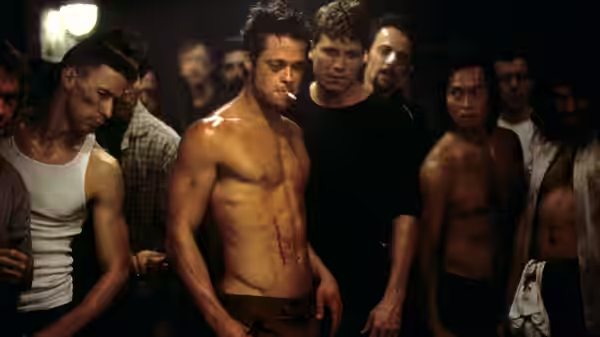
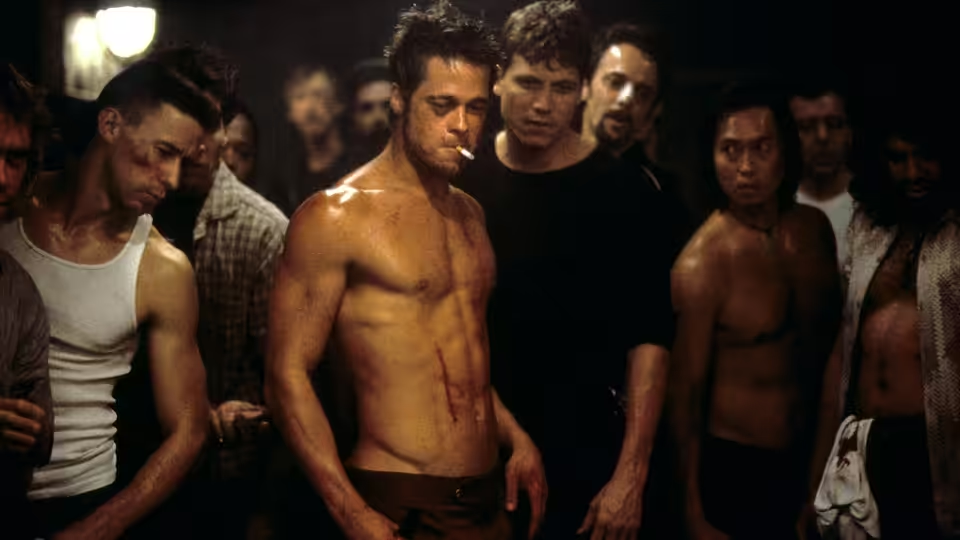
Tyler Durden (Brad Pitt) standing shirtless among a group of men
Film review

Fight Club

1999 · Directed by David Fincher · 2h 19m · MPA R

In a sentenceBrad Pitt makes terrible advice sound like the first interesting thing anyone has said all week

Edward Norton plays the Narrator, a man dissatisfied with conventional success and the consumer culture around him. Tyler Durden (Brad Pitt) challenges his way of life, while his relationship with Marla Singer (Helena Bonham Carter) complicates the wish to escape it. Male frustration, violence and the need for human connection shape a story about looking for something to believe in. David Fincher directs Jim Uhls’s adaptation of Chuck Palahniuk’s novel, with Meat Loaf as Robert Paulson and Jared Leto as Angel Face.

Plays from YouTube when you press play; nothing loads from them until then.

Fi1m review

David Fincher’s Fight Club is an engrossing, cruelly funny satire of male grievance, with Edward Norton and Brad Pitt making its appeal disturbingly clear. The speeches can grow tiresome, but the performances keep the self-pity recognisable and the violence uncomfortable.

David Fincher’s Fight Club understands how pleasant it can be to hear someone else announce that everything is rotten. It is a forceful, often funny film about men whose disgust with ordinary life makes them susceptible to anyone offering permission to behave badly. Fincher gives that temptation room to work, and the result is uncomfortable enough to earn our recommendation. Some of the speeches go on too long, especially when a good complaint is expected to explain everything wrong with modern life.

Jim Uhls’s adaptation of Chuck Palahniuk’s novel gives Edward Norton’s narrator the wit to make self-pity entertaining. Norton is excellent at letting resentment sound reasonable, then allowing just enough petulance into the delivery to make us question the complaint. He makes it easy to imagine how exhausting the man would be in ordinary company, even while we enjoy listening. The writing is funniest when that selfishness remains visible, before anyone starts treating discontent as a qualification for leadership.

Brad Pitt gives Tyler the confidence that Norton so conspicuously lacks, and the casting does a good deal of the film’s work. We found Tyler alarmingly easy to like. Pitt’s easy, amused delivery makes his contempt sound like an invitation to join in. The discomfort comes from recognising how readily that charm excuses what he says. Fincher allows the attraction enough time that dismissing everyone who responds to it would feel dishonest.

Jeff Cronenweth’s cinematography makes the violence difficult to enjoy at a safe distance, keeping our attention on the bodies absorbing it. Alex McDowell’s production design supplies ugliness that is perversely inviting; Fincher’s men seem to have made an aesthetic preference out of their dissatisfaction. James Haygood’s editing finds the abrupt change from amusement to aggression, and the speed helps the jokes sting. John King and Michael Simpson’s music keeps the pressure on, sometimes insistently enough to make us wish it would leave a scene alone.

Helena Bonham Carter’s Marla Singer is essential because she makes the business of dealing with another person feel troublesome again. Bonham Carter brings a welcome impatience to the film, suggesting how tedious all this male certainty might look to somebody outside it. The relationship between Marla and the narrator offers a reason to care when the larger provocations start repeating themselves. We wanted more of that awkwardness, particularly when the film seemed satisfied merely to have found another way of being offensive.

The weakness is how long we are expected to listen to the complaints. Uhls gives these men plenty of things to resent, but also lets them sound pleased with their own cleverness for too long. At 139 minutes, the film gives us time to notice the repetition, especially once Tyler’s confidence has become familiar. Among films about violent male rebellion, its willingness to make that rebellion ridiculous is a considerable strength. Fincher could trust the ridicule more often and shorten the lectures.

The 18 certificate is a useful warning, though the humour may catch us less prepared than the violence. This is an evening for company willing to disagree about what they have just watched. Be suspicious if everyone leaves admiring Tyler for the same reasons.

Critical consensus AI synthesised

74
Positive
13
Mixed
0
Negative
3

Most critics admire it, and the praise gathers around David Fincher’s direction: the hyper-kinetic style, the sardonic wit of the script and the sense that it catches something about male discontent at the end of the 1990s. Pitt and Norton are singled out repeatedly, with Bonham Carter mentioned less often. Several later pieces, Slant and Collider among them, read the film less as anarchist tract than as a warped love story, and find its centre in the relationship with Marla.

The reservations are not mild and they cluster in 1999. The Los Angeles Times, The Hollywood Reporter and RogerEbert.com all dismiss it outright, calling it witless, fascist or a celebration of macho posturing that loses its satire as the fights escalate. Empire, otherwise warm, finds the final act implausible. The spread is unusually wide, from 20 to 100 with nothing in the middle, and the later the review, the kinder it tends to be.

The Times
15 March 2024 · ★★★★★ · Kevin Maher
100

The critic calls it a vital, synapse-splitting masterpiece and genius assault on escapism that refutes the very idea of commercial movies. He singles out its pure sensory overload and the way it delivers a movie assault that foreshadows later events while biting the hand that fed it.

Read the full review →
Film Comment
1 September 1999 · Gavin Smith
90*

The critic describes Fight Club as a stunning, mordantly funny and formally dazzling film that points toward a possible future for mainstream cinema beyond bloated mediocrity. He singles out its innovative, dissociative hyperrealism and the subversive force of Tyler Durden as a galvanizing element that destabilizes the protagonist's conformist world.

Read the full review →
Sight and Sound
1 December 1999
90*

The critic praises Fincher's sophisticated conundrum of a film as a dazzling entertainment that luxuriates in violence even as it condemns it, while highlighting its brilliant depiction of the divided self through the protagonist's split identity.

Read the full review →
The New York Times
15 October 1999 · Critic's Pick · Janet Maslin
90*

Fincher's savage Fight Club is the more visionary and disturbing of two films about businessmen rebelling against middle-class masculinity. It touches a raw nerve with its sardonic, testosterone-fueled ideas about contemporary manhood and lost masculine authority.

Read the full review →
Time Out
24 December 2014 · TCh
90*

The review calls the film a cerebral comedy full of startling, provocative and subversive ideas that are also funny, highlighting its stylish direction, clever screenplay and the way it gets under the skin with its anarchic energy and coup de grâce ending.

Read the full review →
Variety
13 September 1999 · festival review
90*

Fight Club is perfectly keyed into millennium malaise, pitting nihilism against a need for something to grasp onto, with Fincher finding his most disturbing subject matter yet in Palahniuk’s novel. The clever, savagely witty script balances the director’s coldly atmospheric style.

Read the full review →

Straight answers AI written, from our review

Is Fight Club worth watching?
Fight Club is worth watching for anyone with the stomach for a cruel, funny satire of male grievance, and we scored it 81. Edward Norton and Brad Pitt make its appeal disturbingly clear, and Jeff Cronenweth's cinematography keeps the violence uncomfortable rather than thrilling. The speeches run long, and at 139 minutes we noticed the repetition.
How long is Fight Club, and what is it rated?
Fight Club runs 2h 19m and is rated R by the MPA in the US. It is a drama and thriller film.
Where can I watch Fight Club in the US?
Fight Club is available to rent from Amazon Prime Video from $3.99. Availability is checked daily; the links above go straight to each service.
How violent or frightening is Fight Club, and is it suitable for children?
Fight Club carries an 18 certificate in the UK and is not suitable for children or younger teenagers. The fights are shot to keep attention on the bodies absorbing the blows, so the violence is hard to enjoy at a distance, and the humour is coarse enough to catch some viewers off guard. The squeamish should think twice.
How does Fight Club compare to American Psycho?
Fight Club and American Psycho are both satires of male vanity made funny enough to cause discomfort, but they differ in temper. Fincher's film is the more forceful and the more indulgent, letting its men talk at length; Harron's is exact and colder, with Christian Bale's Bateman more ridiculous than seductive. We recommend both, and prefer the leaner comedy of American Psycho if the lectures try your patience.
Is Fight Club based on a true story or a book?
Fight Club is based on Chuck Palahniuk's novel, adapted for the screen by Jim Uhls, and is not a true story. The script gives Edward Norton's narrator the wit to make self-pity entertaining, and Uhls also lets the men admire their own cleverness for too long. Knowing the book is not necessary to follow the film.
What should I watch after Fight Club?
After Fight Club, try American Psycho (2000, Fi1m 80): Corporate status anxiety and male vanity, made funny enough to cause discomfort. Then La Haine (1995, Fi1m 90): Male pride and frustrated anger acquire consequences no amount of swagger can dismiss; and Seconds (1966, Fi1m 84): A fresh identity promises escape from ordinary life, with deeply unsettling results.

Cast

Awards

Total Film Magazine Award, 2005

Won
Total Film Magazine Award

Online Film Critics Society Awards, 2001

Won
Online Film Critics Society Awards

Academy Awards, 2000

Nominated
Best Sound Editing

Jupiter Award, 2000

Won
Jupiter Award

Online Film & Television Association Award, 2000

Won
Online Film & Television Association Award

If you liked this, try…

  1. American Psycho (2000, Fi1m 80)Corporate status anxiety and male vanity, made funny enough to cause discomfort.

  2. La Haine (1995, Fi1m 90)Male pride and frustrated anger acquire consequences no amount of swagger can dismiss.

  3. Seconds (1966, Fi1m 84)A fresh identity promises escape from ordinary life, with deeply unsettling results.

  4. Cure (1997, Fi1m 85)A quieter, colder thriller about violence and the frightening ease of persuasion.

  5. Network (1976, Fi1m 86)Anger becomes a public performance, and the people selling it do rather well.

Free account

Know what to watch tonight

Two lists that know where things are streaming, collections you can share, your own score beside ours, and Discover that remembers what you have seen.

  • Want to see, sorted by what is streaming now
  • Seen, with your score out of ten
  • No adverts, ever