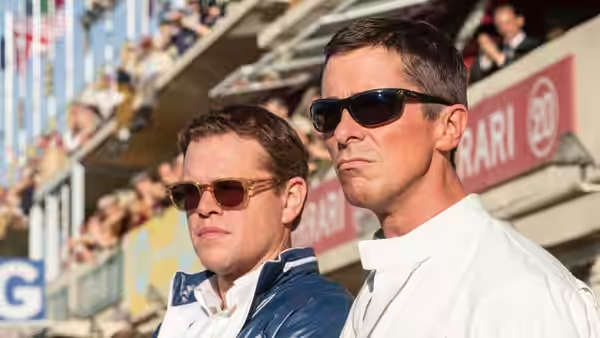
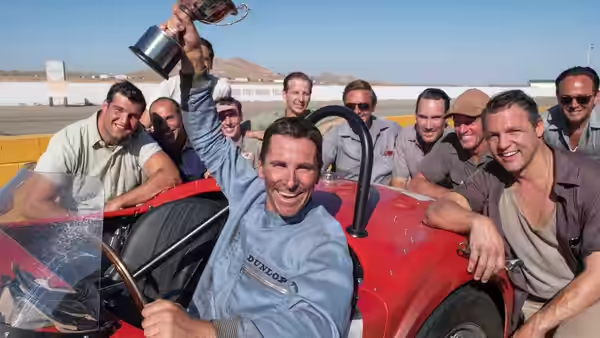
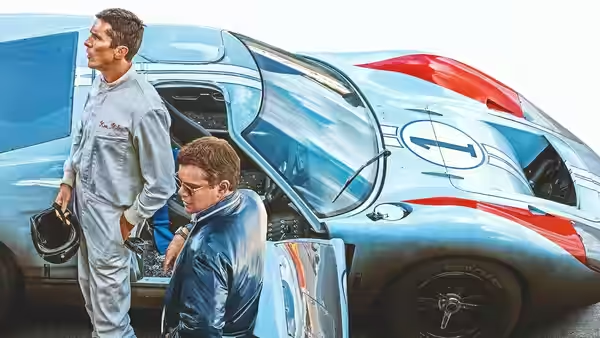
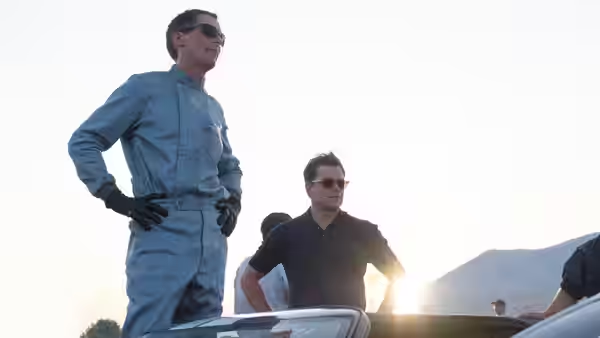
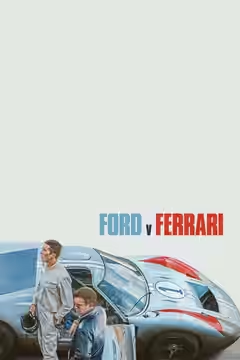
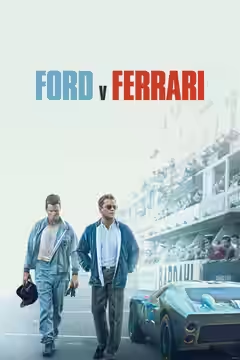
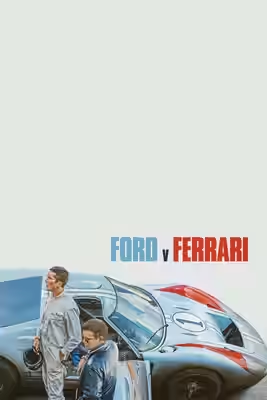
Ken Miles (Christian Bale) and Carroll Shelby (Matt Damon) walking past a blue race car
Film review

Ford v Ferrari

2019 · Directed by James Mangold · 2h 33m · MPA PG-13

In a sentenceAll that engineering, and nobody can build a manager Christian Bale can tolerate

Carroll Shelby (Matt Damon) and racing driver Ken Miles (Christian Bale) become central to Ford’s rivalry with Ferrari. As competition on the track intensifies, the men contend with corporate interference and the demands of working together. Their friendship brings its own competition, with pride and professional judgement complicating the decisions made around them. James Mangold directs a drama that follows the people behind the cars as well as those who control the business. Tracy Letts plays Henry Ford II and Remo Girone plays Enzo Ferrari, with Caitríona Balfe as Mollie Miles and Noah Jupe as Peter Miles.

Plays from YouTube when you press play; nothing loads from them until then.

Fi1m review

Matt Damon and Christian Bale make James Mangold’s racing drama worth the long evening. The driving is gripping and the friendship persuasive, though the corporate interference becomes repetitive long before the script lets it go.

James Mangold’s Ford v Ferrari is a fine racing drama whose familiar writing is mostly overcome by the pleasure of watching its leads. It takes professional skill seriously, allowing pride and technical judgement to matter alongside the competition. The friendship between Carroll Shelby and Ken Miles gives us people worth following through the Ford-Ferrari rivalry. Mangold trusts that capable men can be interesting even when they are being difficult.

Matt Damon plays Shelby and Christian Bale plays Miles, and the difference between their performances gives the friendship its humour. Bale plays Miles’s impatience for laughs without losing sight of the driver’s ability. Damon is quieter, and his restraint allows Shelby to remain a convincing partner rather than merely the audience for Bale’s performance. Their competitive pride makes the friendship credible: admiration does not stop either man wanting his own way, or finding his colleague hard work.

Phedon Papamichael’s cinematography is particularly effective inside the cars, where we can see what the speed demands of the driver. Editors Andrew Buckland, Dirk Westervelt and Michael McCusker keep the racing easy to follow without making it feel safe. We were tense in the cockpit scenes because Bale makes controlling the car look like continuous, exhausting work. His concentration makes the next decision matter, and the cutting gives us enough time to register that effort.

François Audouy’s production design gives the boardroom scenes a convincing formality, which helps the corporate interference feel rooted in a workplace. Buck Sanders and Marco Beltrami’s score adds momentum to the racing, though the driving supplies quite enough excitement of its own. These contributions serve Mangold’s preference for clear, accessible drama, and the film remains easy to follow even when the characters are arguing over expertise.

The screenplay by Jez Butterworth, John-Henry Butterworth and Jason Keller becomes less satisfying whenever it returns to the corporate obstruction. We understand why the racers resent being managed long before the script finishes making the case, and each fresh difficulty starts to feel like another demonstration of the same complaint. That leaves some of the people outside the central friendship looking thinly conceived. Ferrari receives too little attention for the rival manufacturer to become interesting in its own right.

The underdog story is a slightly awkward fit for a contest between manufacturers, but Mangold keeps the emphasis on the men whose judgement can be overruled. That makes the sporting formula easier to accept: we are rooting for their expertise to count for something. The sentiment is familiar, and the film sometimes insists on it after the actors have already earned our sympathy. At 153 minutes, a little less reinforcement would help.

Give it the full evening if a friendship conducted through competition sounds appealing. Damon and Bale make the stretches between races companionable, even when the writing is marking time. There is no need to know what is under the bonnet.


Critical consensus AI synthesised

73
Positive
7
Mixed
3
Negative
0

Most critics find Ford v Ferrari an entertaining, old-fashioned sports drama, with praise concentrated on the racing sequences and the partnership between Christian Bale and Matt Damon. Bale’s eccentric Ken Miles draws particular attention, while the contrast between the leads gives the mechanical and corporate detail a human centre. The reviews generally credit James Mangold with making the on-track action gripping and physically immediate, even when the story follows familiar genre beats.

The main disagreement concerns how much the performances and racing compensate for the formula. Reservations cluster around sentimentality, cautious storytelling and stretches that could be tighter, with responses ranging from enthusiastic approval to sharper dissatisfaction. /Film finds the action thrilling but the scenes off the track dull and clichéd. Slant Magazine is more resistant to the nostalgic treatment of the car industry, though it welcomes the cynicism about corporate interference.

Empire
11 November 2019 · Nick de Semlyen
80*

The critic praises the film's high-velocity bromance powered by zesty acting and Mangold’s meticulous direction, while highlighting the gripping racing sequences in the final act and the contrasting central performances of Bale and Damon.

Read the full review →
Radio Times
14 November 2019 · ★★★★
80

The critic praises the film's playful energy, Bale stealing the show as the eccentric driver, and the exhilarating racing climax that makes it a sure-fire crowd-pleaser.

Read the full review →
The New Yorker
8 November 2019 · Anthony Lane
80*

The critic calls it James Mangold’s strongest film yet, a character study strapped into an action flick that explores pride and rivalry between the leads and their corporate bosses.

Read the full review →
The Times
15 November 2019
80*

The critic calls the film a frequently silly but richly entertaining and hoot-worthy romp with a gleefully larger-than-life performance from Christian Bale as Ken Miles. The cockpit scenes, Bale's comic timing and the climactic race sequences are singled out for praise despite tonal oddities.

Read the full review →
Total Film
15 November 2019
70*

The critic highlights the full-throttle racing sequences and charismatic performances as strengths, noting that they fuel an otherwise standard sports movie, with the film delivering most effectively in its physical, on-track elements.

Read the full review →
Little White Lies
14 November 2019 · 4/3/3 · David Jenkins
60

The critic calls it solidly entertaining Friday-night pulp with strong performances, especially Bale's, but notes it is risk-averse and does not push boundaries.

Read the full review →

Straight answers AI written, from our review

Is Ford v Ferrari worth watching?
Ford v Ferrari is worth watching for anyone who enjoys a friendship conducted through competition, and we scored it 80. Matt Damon and Christian Bale carry the long stretches between races, and the driving itself is tense and easy to follow. The corporate interference becomes repetitive well before the script lets it go, and at 153 minutes the evening is a long one.
How long is Ford v Ferrari, and what is it rated?
Ford v Ferrari runs 2h 33m and is rated PG-13 by the MPA in the US. It is a drama and history film.
Where can I watch Ford v Ferrari in the US?
Ford v Ferrari is available to rent from Amazon Prime Video and Apple TV from $3.99. Availability is checked daily; the links above go straight to each service.
How violent or frightening is Ford v Ferrari, and is it suitable for children?
Ford v Ferrari is a 12A racing drama, and the danger is the speed rather than any violence between people. The cockpit scenes are tense because Bale makes controlling the car look like exhausting work, but nothing in the film is likely to frighten a child old enough for the certificate. Younger children may simply find the boardroom arguments dull.
How does Ford v Ferrari compare to Rush?
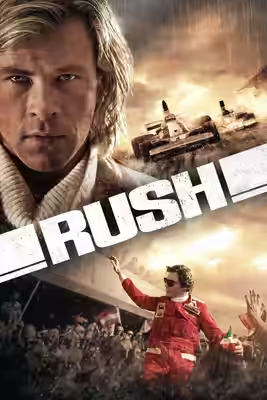
Ford v Ferrari and Rush are both racing dramas built on contrasting temperaments, but Mangold’s film is about a friendship and Howard’s is about a rivalry. Rush is the tenser and the more involving of the two, though its script makes the men too simple; Ford v Ferrari has the warmer pairing in Damon and Bale and the more repetitive off-track writing. Choose Rush for the racing, Ford v Ferrari for the company.
What should I watch after Ford v Ferrari?
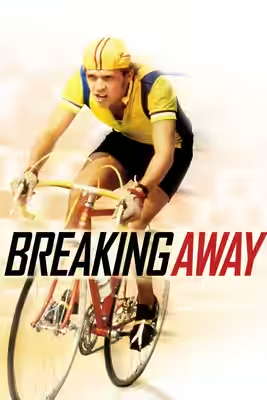
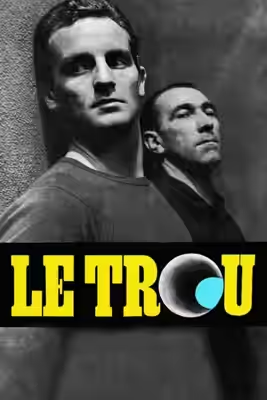
After Ford v Ferrari, try Rush (2013, Fi1m 82): Another racing rivalry where the men’s contrasting temperaments make the competition matter. Then Breaking Away (1979, Fi1m 86): Cycling, class and friendship give this sporting underdog story its comic warmth; and Le Trou (1960, Fi1m 88): Patient attention to skilled manual work makes this prison drama fiercely involving.

Cast

Awards

Academy Awards, 2020

Nominated
Best Picture
Won
Best Film Editing
Won
Best Sound Editing

If you liked this, try…

  1. Rush (2013, Fi1m 82)Another racing rivalry where the men’s contrasting temperaments make the competition matter.

  2. The World's Fastest Indian (2005) · not reviewed yetFor mechanical ingenuity and stubborn ambition, with a gentler leading presence.

  3. Breaking Away (1979, Fi1m 86)Cycling, class and friendship give this sporting underdog story its comic warmth.

  4. Le Trou (1960, Fi1m 88)Patient attention to skilled manual work makes this prison drama fiercely involving.

  5. Seven Samurai (1954, Fi1m 95)Difficult professionals learn to work together, with action grounded in individual skill.

Free account

Know what to watch tonight

Two lists that know where things are streaming, collections you can share, your own score beside ours, and Discover that remembers what you have seen.

  • Want to see, sorted by what is streaming now
  • Seen, with your score out of ten
  • No adverts, ever