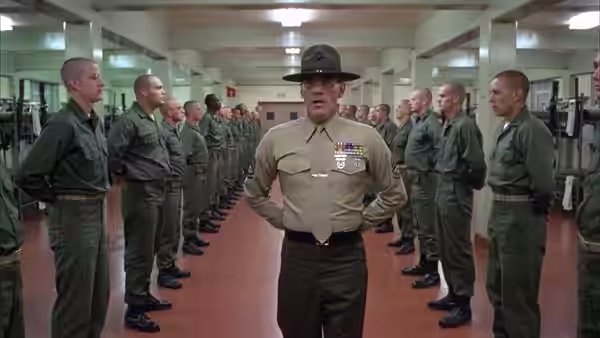
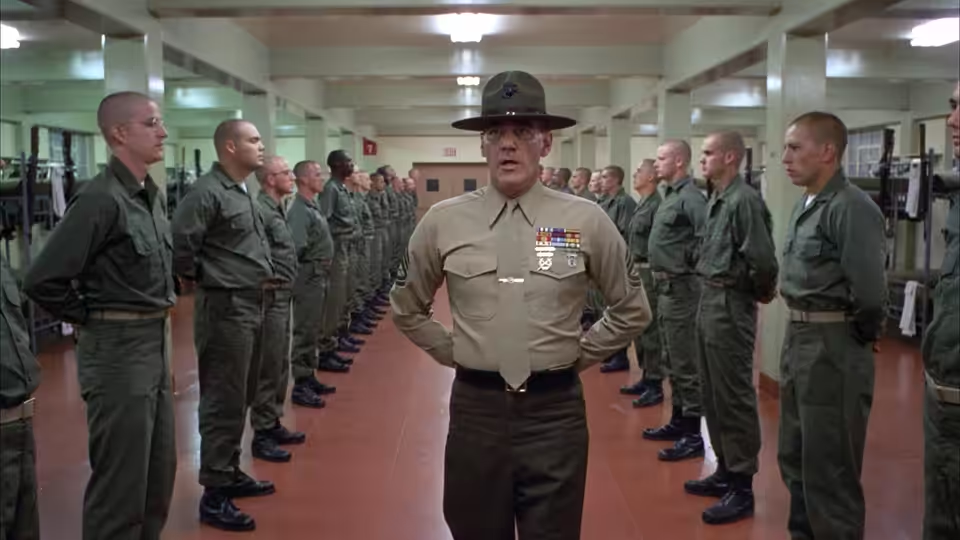
Gny. Sgt. Hartman (R. Lee Ermey) stands hands on hips addressing recruits in formation indoors
Film review

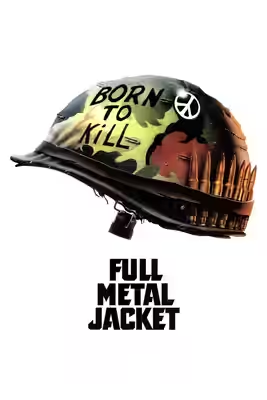
Full Metal Jacket

1987 · Directed by Stanley Kubrick · 1h 57m · MPA R

In a sentenceThe drill sergeant is funny enough to make us ashamed of laughing

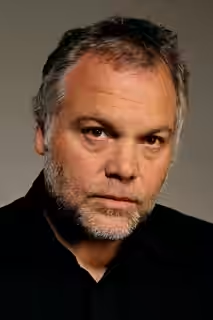
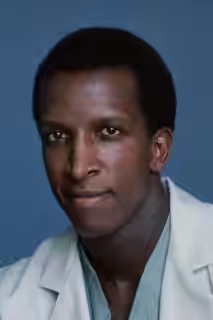
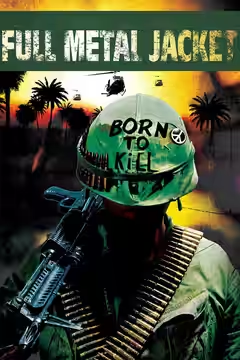
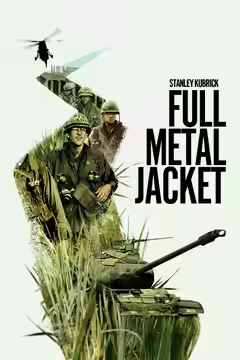
Private Joker (Matthew Modine) and Private Pyle (Vincent D’Onofrio) enter a Marine training programme under Gunnery Sergeant Hartman (R. Lee Ermey). The recruits face a regime of discipline and verbal abuse that aims to prepare them for combat. Stanley Kubrick’s war drama moves from the training camp to a bombed-out city in Vietnam, where the men encounter the fighting they have been trained for. Adam Baldwin plays Animal Mother, with Dorian Harewood as Eightball and Arliss Howard as Private Cowboy among the soldiers.

Plays from YouTube when you press play; nothing loads from them until then.

Fi1m review

Stanley Kubrick’s powerful war drama makes military cruelty horribly entertaining. R. Lee Ermey dominates the training camp; the move to Vietnam loosens the film’s grip, but does not undo its force.

Full Metal Jacket is a powerful war film with a lopsided structure: the training camp is so concentrated that the fighting in Vietnam initially seems diffuse. Stanley Kubrick follows a Marine training programme with combat, asking what remains of a person after the military has taught him how to behave. Much of its force comes from the military language, which makes degradation sound routine. He directs from a screenplay written with Michael Herr and Gustav Hasford.

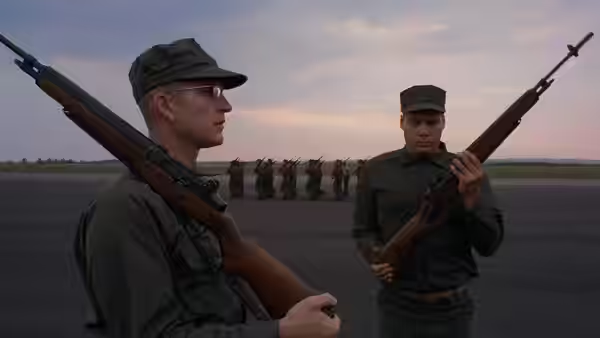
R. Lee Ermey’s Gunnery Sergeant Hartman gives that language an appalling fluency. The insults arrive with such assurance that there hardly seems to be a thought between one humiliation and the next. We laughed at his abuse, then felt ashamed of ourselves. Ermey makes Hartman’s treatment of the recruits entertaining enough for us to register the cruelty a moment late, and Kubrick lets that discomfort stand. Hartman dominates the training section, with Vincent D’Onofrio’s Private Pyle bearing its pressure most visibly.

D’Onofrio gives Pyle a vulnerability that prevents the camp from becoming merely a display of Ermey’s verbal ingenuity. It matters that the training has a visible cost to someone, and that we can recognise the hurt without needing it explained. Matthew Modine’s Private Joker offers a less exposed presence, watchful enough to hold our attention without telling us what to think at every turn. Their performances make the recruits more than illustrations of the director’s point.

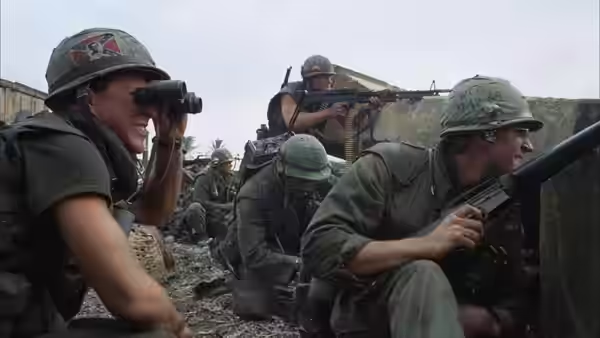
Douglas Milsome’s photography makes the fighting feel uncomfortably close, even when Kubrick’s careful compositions threaten to make it look too arranged. The control is useful in the training camp, where the whole purpose is to regulate men; in combat it can put a little distance between us and their fear. Anton Furst’s production design gives the bombed-out Vietnamese city a forbidding solidity. The surroundings are oppressive without inviting us to admire the destruction.

Martin Hunter’s editing gives the training section time to become exhausting, and the shift to Vietnam interrupts a rhythm we have learnt to dread. That break makes sense, though it takes the film a while to recover its grip. Vivian Kubrick’s music adds unease without competing with the voices for our attention. The pop songs are shrewdly chosen, their familiarity making the surrounding violence harder to settle into. Yet the sound we remember most clearly is Ermey’s speech, which needs little assistance.

As a war film, it is strongest when the military language becomes frightening without anyone explaining why. The screenplay’s political discussions are less effective, sometimes giving the men points to deliver rather than conversations to have. Its bitter humour helps: we cannot simply nod along with a lecture about the cruelty of war. The laughter in the training camp makes it difficult to pretend that the cruelty has nothing to do with us.

Set aside its 117 minutes for an evening when discomfort is part of the attraction. The 18 certificate is worth taking seriously, particularly if verbal humiliation troubles you as much as physical violence. Watch it with someone who will be honest about where they laughed.

Critical consensus AI synthesised

72
Positive
10
Mixed
1
Negative
2

Most critics come down firmly in favour, and the praise gathers in the same place: the boot camp that fills the first half. R. Lee Ermey’s drill sergeant is singled out again and again, with Vincent D’Onofrio and Matthew Modine close behind. Several reviews also credit the two-part structure itself, arguing that the split between training and combat is what sets the film apart from other Vietnam pictures, and that its standing has grown over time.

The reservations cluster just as tightly, on the Vietnam half. RogerEbert.com finds the film shapeless once it leaves the barracks, and Empire finds Kubrick powerful in the camp but unengaged once the fighting starts. Time Out goes further, calling the direction cold and manipulative and the recruits hard to care about. The Hollywood Reporter stands alone in dismissing the whole thing as a didactic misfire. The spread is wide, from full marks to near contempt, but the dissenters are few.

Radio Times
★★★★★ · Adrian Turner
100

Kubrick's penultimate film is a harrowing, foul-mouthed and violent Vietnam War drama that begins with a long training camp sequence before moving to a bombed-out Vietnamese city. Its message is simple but its technique is extraordinary, with superb performances especially from Lee Ermey, Vincent D'Onofrio and Matthew Modine.

Read the full review →
Slant Magazine
20 November 2007
90*

The critic praises the film as one of Kubrick’s grittiest and most resonant works for its unflinching look at the duality of man and the mythologies of war-making. He highlights the two-part structure, strong performances (especially Modine and Ermey), and effective photography that puts viewers in the line of fire.

Read the full review →
The New York Times
26 June 1987 · Vincent Canby
90*

The critic finds Kubrick's film a harrowing, beautiful, and eccentric Vietnam drama that will puzzle and fascinate audiences. It is compared favorably in spirit to Apocalypse Now for its antagonistic and elliptical narrative style drawn from the source novel.

Read the full review →
Los Angeles Times
26 June 1987 · Sheila Benson
85*

Kubrick creates a powerful, clinical statement of outrage about the perversion of innocence through militarism, with the two sections not perfectly balanced but still a muscular return to form. It singles out the pitiless basic training sequences and the lacerating edge given to familiar battle moments for their horrifying impact.

Read the full review →
Little White Lies
5 May 2019 · William Carroll
80*

The film stands apart by focusing on individual soldiers' psyches and personal narratives rather than collective or epic war stories. It singles out the intimate, pared-down sequences in Hue City and Private Pyle's harrowing arc for their chilling portrayal of psychological damage.

Read the full review →
Vulture
31 December 2025
80*

The film is celebrated for its first half's performances by R. Lee Ermey and Vincent D’Onofrio, with the second half in Vietnam equally strong in showing the effects of dehumanization. Its reputation has grown over time despite initial perceptions as just another Vietnam War picture.

Read the full review →

Straight answers AI written, from our review

Is Full Metal Jacket worth watching?
Full Metal Jacket is worth watching for anyone prepared to be made uncomfortable, and we scored it 81. Stanley Kubrick's training camp, dominated by R. Lee Ermey's drill sergeant, is the concentrated part; the move to Vietnam loosens the film's grip for a while without undoing its force. Choose an evening when discomfort is part of the attraction.
How long is Full Metal Jacket, and what is it rated?
Full Metal Jacket runs 1h 57m and is rated R by the MPA in the US. It is a drama and war film.
Where can I watch Full Metal Jacket in the US?
Full Metal Jacket is streaming on HBO Max, The Roku Channel and Amazon Prime Video in the US, and it is also available to rent from Amazon Prime Video from $5.99. Availability is checked daily; the links above go straight to each service.
How violent or frightening is Full Metal Jacket, and is it suitable for children?
Full Metal Jacket carries an 18 certificate in the UK and is not suitable for children. The violence in the training camp is largely verbal, a sustained regime of humiliation that we found as troubling as the combat that follows, and the fighting in Vietnam is shot close enough to feel uncomfortably near. Take the certificate seriously.
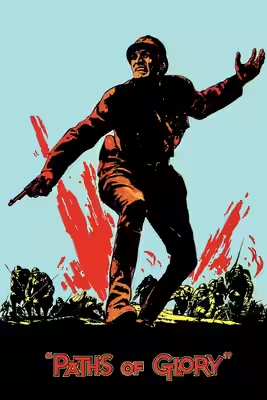
How does Full Metal Jacket compare to Paths of Glory?
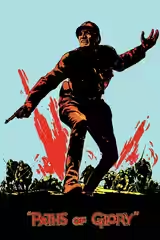
Full Metal Jacket and Paths of Glory are both Stanley Kubrick war films about military cruelty, but they work differently. The earlier film is the more controlled and, through Kirk Douglas's Colonel Dax, the more openly moving; the later one is more bitterly funny and more lopsided, its training camp stronger than its combat. Choose Paths of Glory for anger, Full Metal Jacket for the laughter you regret.
Is Full Metal Jacket based on a true story or a book?
Full Metal Jacket is based on a novel by Gustav Hasford, not directly on a true story, though it follows a Marine training programme and the fighting in Vietnam that follows it. Hasford worked on the screenplay with Stanley Kubrick and Michael Herr. You do not need to have read the book; the film's force lies in its military language, which needs no introduction.
What should I watch after Full Metal Jacket?
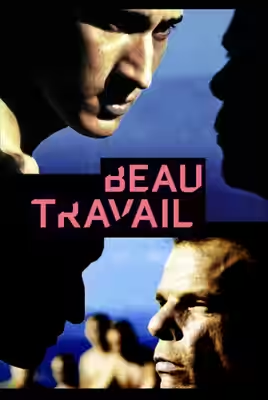
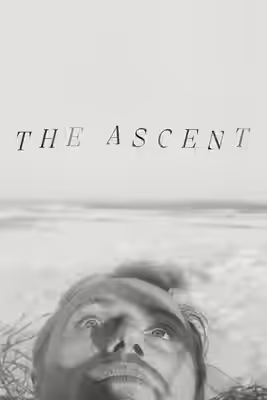
After Full Metal Jacket, try Paths of Glory (1957, Fi1m 93): Kubrick examines military authority through men forced to answer for their commanders. Then Beau Travail (1999, Fi1m 86): Military routine, male rivalry and bodies drilled into obedience, with far less talk; and The Ascent (1977, Fi1m 88): A wartime ordeal that gives its moral questions an intimate, human weight.

Cast

Awards

Academy Awards, 1988

Nominated
Best Writing, Adapted Screenplay

Boston Society of Film Critics Award for Best Director, 1988

Won
Boston Society of Film Critics Award for Best Director

Boston Society of Film Critics Award for Best Supporting Actor, 1988

Won
Boston Society of Film Critics Award for Best Supporting Actor

David di Donatello for Best Producer, 1988

Won
David di Donatello for Best Producer

If you liked this, try…

  1. Paths of Glory (1957, Fi1m 93)Kubrick examines military authority through men forced to answer for their commanders.

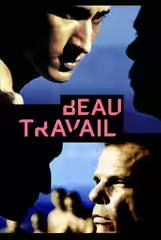
  2. Beau Travail (1999, Fi1m 86)Military routine, male rivalry and bodies drilled into obedience, with far less talk.

  3. The Ascent (1977, Fi1m 88)A wartime ordeal that gives its moral questions an intimate, human weight.

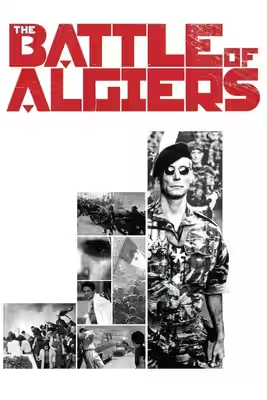
  4. The Battle of Algiers (1966, Fi1m 93)Urban warfare and institutional violence, filmed with a disturbing sense of proximity.

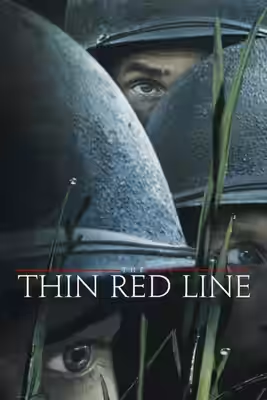
  5. The Thin Red Line (1998, Fi1m 84)Combat seen through uneasy individual minds, with more room for tenderness.

Free account

Know what to watch tonight

Two lists that know where things are streaming, collections you can share, your own score beside ours, and Discover that remembers what you have seen.

  • Want to see, sorted by what is streaming now
  • Seen, with your score out of ten
  • No adverts, ever