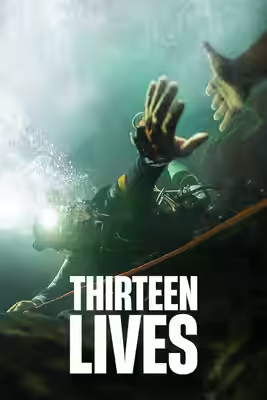
Alex Parkinson turns his own documentary into a lean, procedural thriller, and for its middle stretch it is as tense as the genre gets. The people on either side of the accident, though, stay about as sketched as their radio call signs.
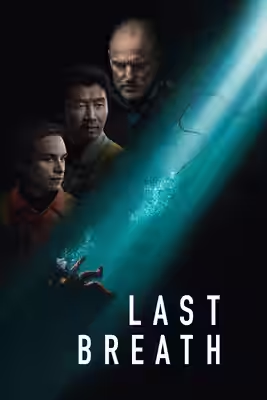
Alex Parkinson has told this story once already, in a 2019 documentary of the same name with the real people on camera. Now he has gone back and staged it with actors, and the result is a 93-minute, 12A thriller that knows exactly what its one good idea is and spends the first twenty minutes and the last ten slightly at a loss for what to do around it. The middle is very good indeed. We recommend it, with the plain caveat that you will not remember anyone’s name a week later, and the film does not much mind.
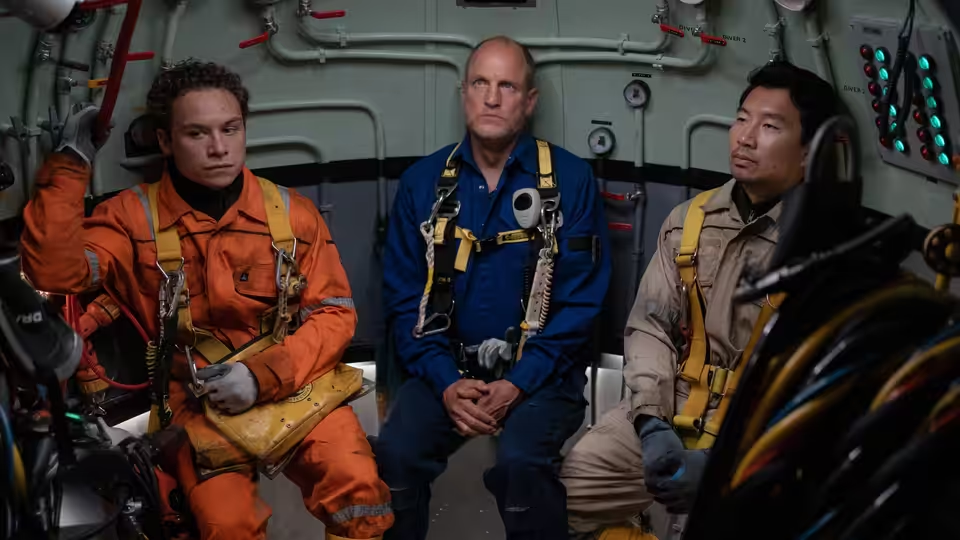
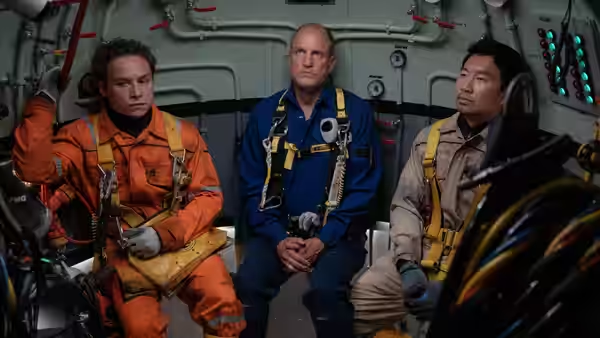
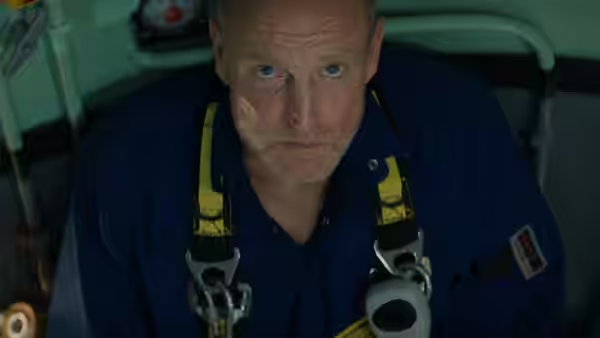
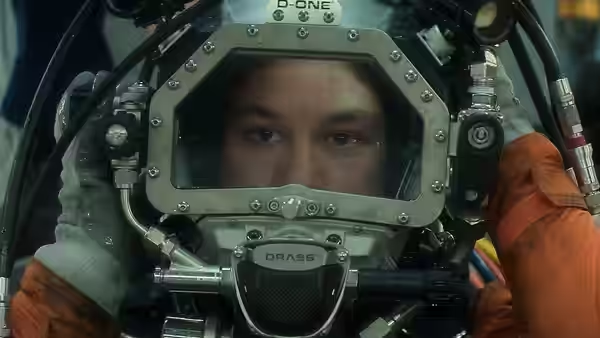
The idea is saturation diving, which the script, by Parkinson, Mitchell LaFortune and David Brooks, explains in about four lines and one well-chosen shot. Divers working at depth for weeks live pressurised the whole time, in a steel tube of bunks and valves aboard the ship, so they can go down and come back without decompressing each time. Grant Montgomery builds that chamber so low that Woody Harrelson has to duck, and the film gets more out of the three men eating dinner in it than out of anything set on land. Harrelson plays Duncan as the sort of colleague who has a paperback and a remark for every situation, and he is the film’s only source of ease.
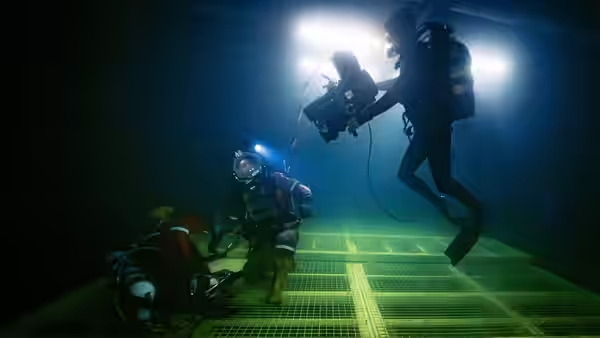
Then the bell goes down and the film finds its shape. The storm rises, the ship’s positioning system fails, and the vessel starts to drag its divers across the seabed by their lines. Tania Goding cuts between four rooms, the bridge, dive control, the bell and the black water outside it, and she never stays in one long enough for us to feel safe. Ian Seabrook and Nick Remy Matthews shoot the seabed as nothing at all, a cone of helmet light and then dark, and the surface as grey water coming over the rail. When Chris’s umbilical parts and his voice simply drops out of the radio, we realised we had stopped breathing ourselves. It was the silence that did it, not the alarms.
What follows is a rescue conducted by people who cannot see the man they are rescuing, and the film is at its best when it trusts that. Mark Bonnar, running dive control, gives Craig a Scottish voice that refuses to rise however many red lights come on, and the steadiness is more alarming than shouting would have been. Cliff Curtis has one decision to make on the bridge and makes it without a speech. Simu Liu plays Yuasa as almost blank, and in the water, where the job is to be a pair of hands that do not shake, it works; on the ship it reads as an actor waiting to be given something. Finn Cole is earnest and open and spends much of the film alone on the seabed, which is a hard place to act from.
The frame around the accident is where the film lets itself down. Morag and the half-built house are there to give Chris a reason to live, and they are written as exactly that and nothing more. Duncan’s enforced retirement is set up as a grievance and then left where it was put. The dialogue in the crisis is the dialogue people actually use in a crisis, short and functional, which is honest and also means nobody says a line worth quoting. Paul Leonard-Morgan’s score is a low pulse for most of the running time and is right to be, but in the long stretch of waiting it thickens and starts doing the acting the script has declined to write.
The documentary had the real men and the real underwater footage, and the drama cannot add feeling to that; what it adds is scale, a seabed we can see, and a storm we can hear. Against the genre it does well. Apollo 13 also spent its length in rooms full of people reading instruments, and this is nearly as good at making a gauge frightening, though far less good at making us care who is watching it.
See it in a cinema if you can, for the dark, which is the point. At home the seabed becomes a very quiet screensaver and the film shrinks with it. Either way, it will make you conscious of your own breathing for about forty minutes, and then you will go and make a cup of tea and forget most of the people who put you through it.