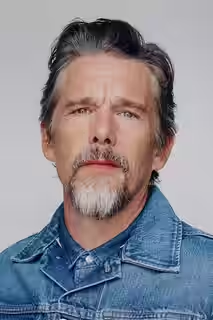
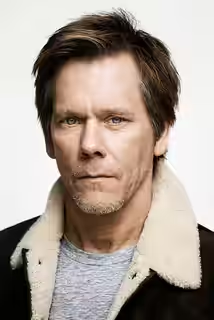
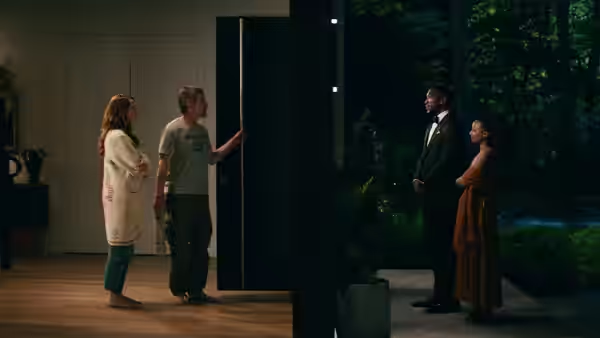
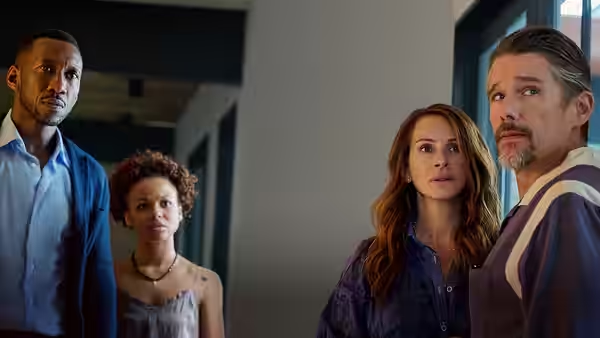
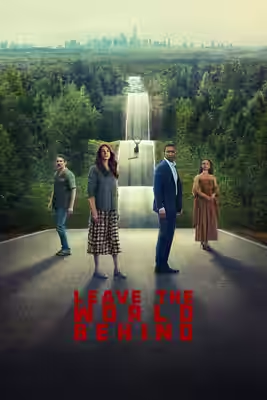
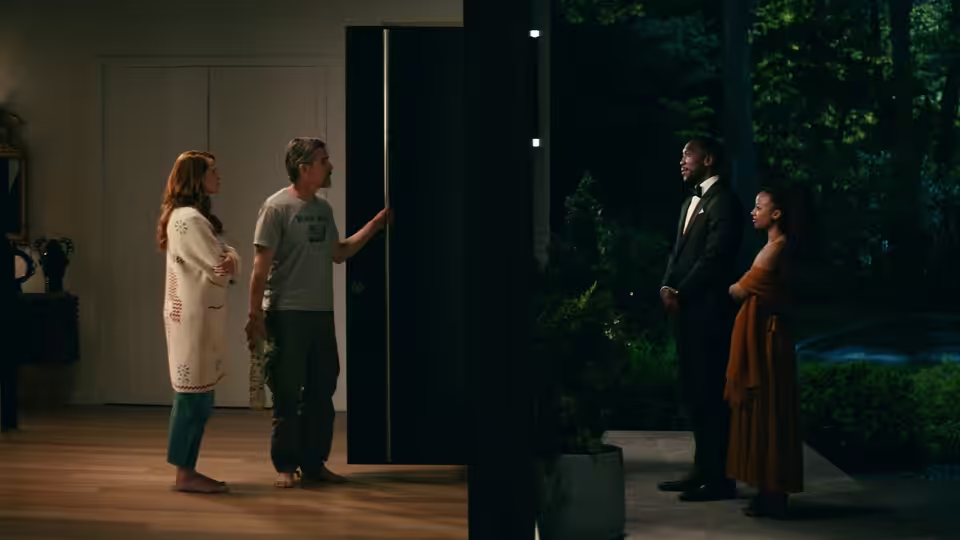
Amanda Sandford (Julia Roberts) and Clay Sandford (Ethan Hawke) opening door to G.H. Scott (Mahershala Ali) and Ruth Scott (Myha'la Herrold)
Film review

Leave the World Behind

2023 · Directed by Sam Esmail · 2h 20m · MPA R

In a sentenceThe world ends, the wifi goes first, and the camera does a somersault about it

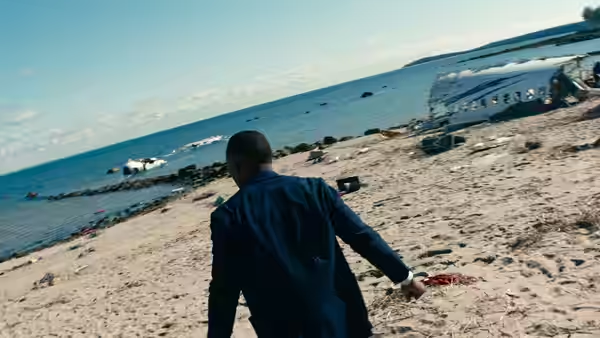
Amanda Sandford (Julia Roberts) books a house on Long Island for a few days away with her husband Clay (Ethan Hawke) and their children Rose (Farrah Mackenzie) and Archie (Charlie Evans). On the first afternoon an oil tanker runs aground on the beach in front of them. That night the phones and the television stop working, and two strangers in evening dress, G.H. Scott (Mahershala Ali) and his daughter Ruth (Myha’la), knock at the door saying the house is theirs and asking to stay. Sam Esmail writes and directs from Rumaan Alam’s novel, with Kevin Bacon as a neighbour. It runs 140 minutes and carries a 15.

Plays from YouTube when you press play; nothing loads from them until then.

Fi1m review

Sam Esmail’s apocalypse fits inside one expensive house, and for an hour it is tense, funny and handsomely made. Then it starts telling us what it means, and it means less than it thinks; Roberts is the reason to stay.

Sam Esmail takes Rumaan Alam’s novel and keeps its shape: one family rents a house on Long Island for a few days, the phones stop working, and the people who own the house turn up in the middle of the night asking to be let in. Amanda Sandford (Julia Roberts) booked it on impulse because, as she says in the opening scene, she hates people. Her husband Clay (Ethan Hawke) is agreeable and useless, and their children Rose (Farrah Mackenzie) and Archie (Charlie Evans) want a screen. G.H. Scott (Mahershala Ali) and his daughter Ruth (Myha’la) arrive in evening dress with a story about a blackout in the city. For an hour this is a good, mean, well-acted chamber piece. When the world outside the house gets bigger, the film gets smaller.

Roberts is the reason to stay. Amanda says the unkind thing first and defends it second, and Roberts plays her without once asking us to forgive her. Ali gives G.H. the patience of a man who has spent his life waiting to be believed, and the scene on the porch where he proves he owns the house to a woman who does not want to hear it is the best written thing in the film. Hawke plays Clay as a man who cannot read a paper map and knows it. Myha’la’s Ruth gets the sharpest lines and has to aim most of them at Amanda.

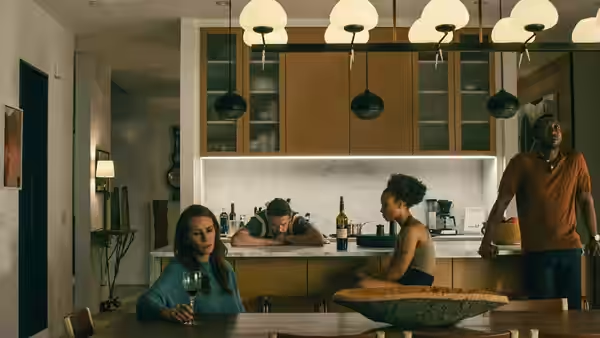
Tod Campbell’s camera will not sit still. It climbs over the roof, spins through a ceiling into the room below, and follows the car from directly above like a drone that has lost interest in the road. For the first hour this works: the house is filmed as a place watched from outside, and the people in it look small. By the second hour it is a habit, and we began to notice the moves rather than what they were showing us. Anastasia White’s house is glass, concrete and pale wood with a pool the colour of a phone screen. Catherine Marie Thomas keeps the Scotts in black tie and the Sandfords in holiday clothes, so we never forget who dressed for the evening.

The tanker got us. A red hull appears on the horizon while the family sits on the beach, it grows, and nobody moves until it is far too late, and we felt it in the stomach because Lisa Lassek holds the wide shot instead of cutting to faces. It is the one sequence where the size of what is happening lands without anyone explaining it. The deer are the opposite. They gather in ranks on the lawn and stare, and the effect is closer to a screensaver than a threat. Mac Quayle’s score, strings over a low electronic hum with something like a siren threaded through, does more of the work than the animals do.

The trouble is the writing. Esmail, who also wrote the screenplay, has each character say aloud, at some point, what they stand for. G.H. gets a speech about how societies come apart. Ruth gets one about trust. Amanda gets one about hating people, again. The film wants to talk about race and money and what we owe strangers, and it does talk about them, at length, in place of dramatising them. Rose’s determination to see the last episode of Friends is the best running joke, and it is also the point of the film, and it says more than any of the speeches. Kevin Bacon appears late as a neighbour named Danny, does ten minutes of pure suspicion, and we missed him when he had gone.

Esmail made Mr. Robot for television, and this feels like a miniseries folded into 140 minutes: episodes rather than acts, a cliffhanger every twenty minutes, a habit of ending scenes on a look. Most critics have liked it more than we did, and they are right about the cast and the first hour. But the film explains more than the novel did, and every explanation makes the mystery a little more ordinary. By the last half hour we had stopped being frightened and started waiting to be told, and being told was not worth the wait.

See it for Roberts, for the tanker and for the porch. It was plainly built for a sofa, where the camera’s somersaults are less tiring and the speeches easier to talk over. It runs 140 minutes and carries a 15.

Critical consensus AI synthesised

67
Positive
9
Mixed
2
Negative
2

Most critics like it, but the spread is wide. The praise settles on the cast: Julia Roberts is named again and again, with The Telegraph calling this her strongest cinema role in years, and Mahershala Ali and Ethan Hawke are singled out nearly as often. The reviews also agree that Esmail builds tension well in the first half, when two families are shut in a luxury house with the internet gone, and several note the off-kilter camerawork.

The reservations gather around what happens once the crisis widens. The New York Times finds the film less effective the more explicit it becomes, Vulture finds the characters thin and the disaster sequences half-finished, and Empire says it never settles on a target. Several middling reviews complain that the politics are heavy-handed and that the ending withholds too much. The keenest supporters say the vagueness is the point; the doubters say it is a shrug dressed as profundity.

Screen Daily
26 October 2023 · festival review
80*

With Hitchcockian flair, it's a confident, entertaining thriller with excellent performances and superb escalation of tension; singles out Julia Roberts' commanding turn and the ensemble.

Read the full review →
The Guardian
26 November 2023
80*

The critic describes the film as a cracking apocalyptic thriller that is sharp-witted, bracingly bleak and immensely enjoyable. They single out the superb performances by Julia Roberts and Mahershala Ali along with the film's big-hitting ambition and spectacle tempered by humour.

Read the full review →
The Telegraph
8 December 2023 · ★★★★ · Chief Film Critic
80

The critic praises the film as an enthralling thriller in which Julia Roberts delivers her best cinema role in years. They highlight the recognisable human behaviour driving the story and the way it plays on social tensions without becoming preachy.

Read the full review →
Variety
26 October 2023 · festival review · Peter Debruge
75*

Esmail delivers an intriguing, slow-burn thriller focused on human behavior and prejudice under pressure, with strong character work and a satisfying final scene.

Read the full review →
Radio Times
★★★ · James Mottram
60

The critic finds it a fitfully engaging apocalypse drama with some spectacular sequences like the oil tanker but others like the deer herd that don't work; praises Julia Roberts' performance and the funny Friends subplot, notes it might suit TV better.

Read the full review →
RogerEbert.com
5 December 2023 · Robert Daniels
55*

The film understands post-apocalyptic mechanics and features strong performances and dynamic camerawork but fails to generate meaningful stakes or emotional depth.

Read the full review →

Straight answers AI written, from our review

Is Leave the World Behind worth watching?
Leave the World Behind is worth watching for its first hour and for Julia Roberts, and we scored it 60. Sam Esmail's apocalypse in one expensive Long Island house is tense, funny and handsomely made until the characters start making speeches about what it all means. See it on a sofa, where the spinning camera tires less and the speeches are easier to talk over.
How long is Leave the World Behind, and what is it rated?
Leave the World Behind runs 2h 20m and is rated R by the MPA in the US. It is a drama and mystery film.
Where can I watch Leave the World Behind in the US?
Leave the World Behind is streaming on Netflix in the US. Availability is checked daily; the links above go straight to each service.
How violent or frightening is Leave the World Behind, and is it suitable for children?
Leave the World Behind carries a 15 in the UK and an R in the US, and it is a slow-building thriller of dread rather than a violent one. The frightening moments are a tanker running aground on a beach and a growing sense that nobody knows what is happening outside. It is not for children, and older teenagers may find the talk outweighs the fear.
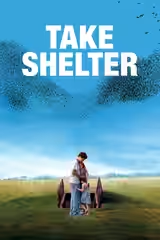
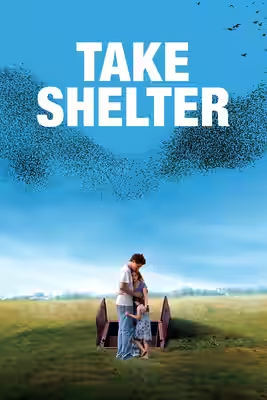
How does Leave the World Behind compare to Take Shelter?
Leave the World Behind and Take Shelter both trap a family inside a catastrophe nobody can fully see, but the earlier film is the more disciplined of the two. Jeff Nichols keeps his dread small and his marriage at the centre, while Esmail's film is glossier, busier with the camera and far talkier. Choose Take Shelter for sustained unease and Michael Shannon; choose this for Roberts and the first hour.
Is Leave the World Behind based on a true story or a book?
Leave the World Behind is based on Rumaan Alam's novel of the same name, not on a true story. Sam Esmail keeps the book's shape, one family renting a house and the owners arriving in the night, but explains more than the novel did, and each explanation makes the mystery more ordinary. You need not have read it, though readers may miss the ambiguity.
What should I watch after Leave the World Behind?
After Leave the World Behind, try Take Shelter (2011, Fi1m 83): A storm nobody else can see, and a marriage that has to survive it. Then The Birds (1963, Fi1m 86): Hitchcock’s original version of nature turning up on the lawn and staring; and Melancholia (2011, Fi1m 80): The end of the world at a country house, with far better wedding planning.

Cast

If you liked this, try…

  1. Take Shelter (2011, Fi1m 83)A storm nobody else can see, and a marriage that has to survive it.

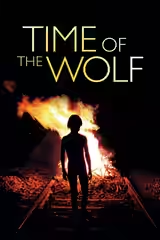
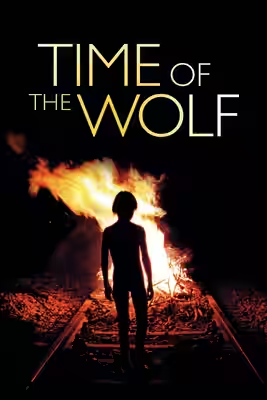
  2. Time of the Wolf (2003) · not reviewed yetHaneke’s apocalypse never explains itself once, and is the more frightening for it.

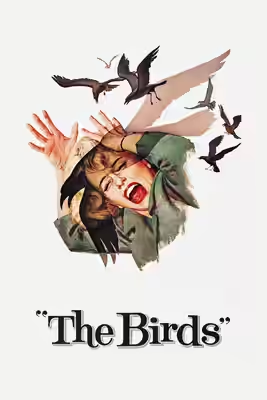
  3. The Birds (1963, Fi1m 86)Hitchcock’s original version of nature turning up on the lawn and staring.

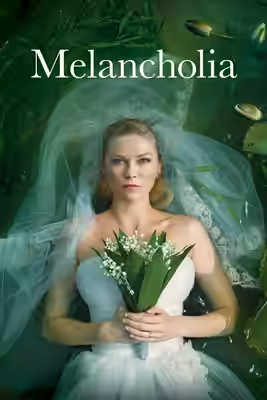
  4. Melancholia (2011, Fi1m 80)The end of the world at a country house, with far better wedding planning.

  5. Miracle Mile (1988) · not reviewed yetOne phone call, one night, and a city with seventy minutes left.

Free account

Know what to watch tonight

Two lists that know where things are streaming, collections you can share, your own score beside ours, and Discover that remembers what you have seen.

  • Want to see, sorted by what is streaming now
  • Seen, with your score out of ten
  • No adverts, ever