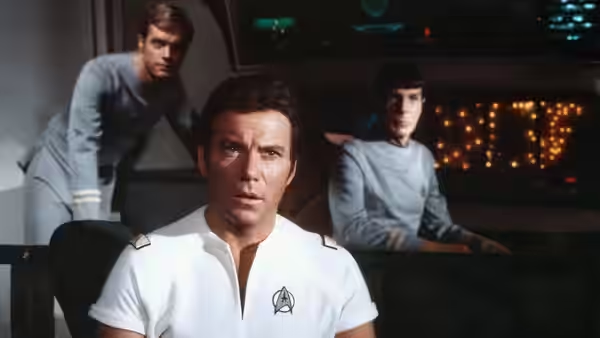
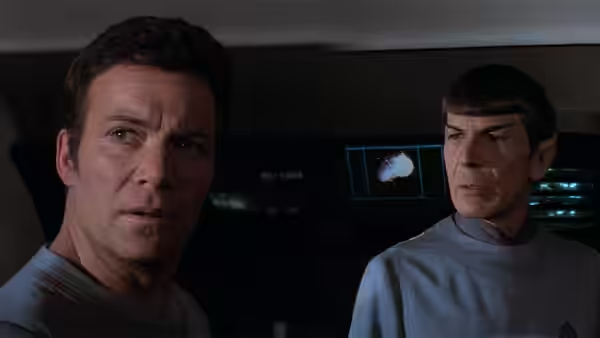
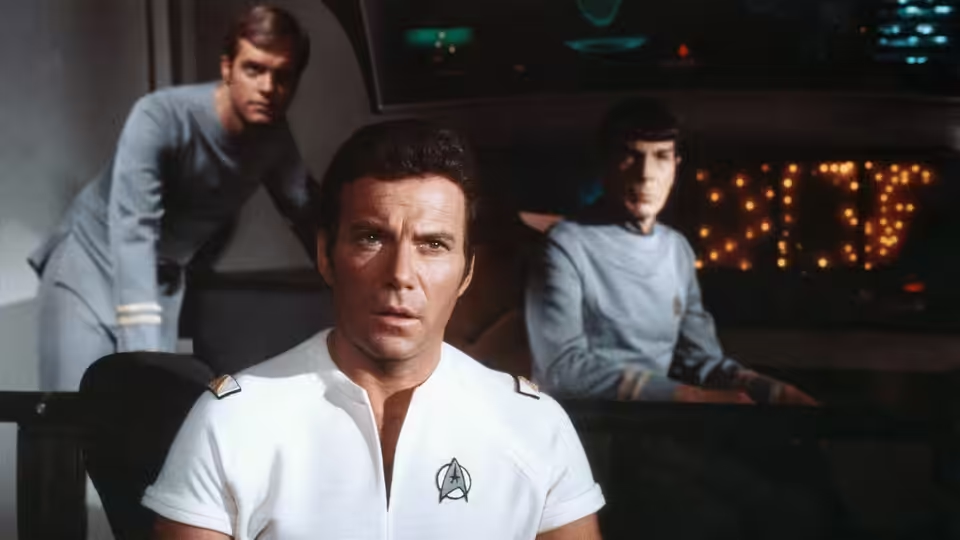
Admiral James T. Kirk seated on the bridge with Spock and another officer
Film review

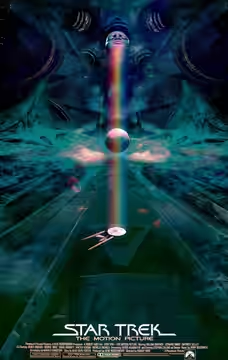
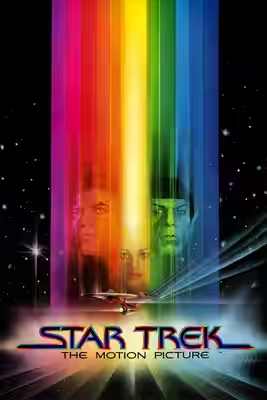
Star Trek: The Motion Picture

1979 · Directed by Robert Wise · 2h 11m · MPA G

In a sentenceA five-minute love scene with a spaceship, then two hours of people staring at a cloud

A vast cloud of energy is crossing space towards Earth, having just destroyed three Klingon cruisers. Admiral James T. Kirk (William Shatner) uses the emergency to take back command of the refitted USS Enterprise from its captain, William Decker (Stephen Collins). Dr. Leonard ‘Bones’ McCoy (DeForest Kelley) is drafted back into uniform against his will, and Lt. Ilia (Persis Khambatta), a navigator with a history with Decker, joins the bridge. On Vulcan, Mr. Spock (Leonard Nimoy) has spent years trying to rid himself of his last emotions, until something in the cloud reaches his mind. The ship leaves drydock before it is ready, with a faulty transporter, a misfiring engine and days to intercept.

Plays from YouTube when you press play; nothing loads from them until then.

Fi1m review

Robert Wise sends the Enterprise crew, a decade older, into a cloud and asks us to be patient. Jerry Goldsmith’s score and Harold Michelson’s ship reward the wait; Harold Livingston’s script mostly does not, and the middle hour is long.

Gene Roddenberry got his television crew back, a budget to match, and Robert Wise to direct. What it is aiming at is plain from the first frame: 2001: A Space Odyssey (1968) with familiar faces, not Star Wars (1977) with pointed ears. A cloud is coming for Earth, the Enterprise is sent to meet it, and for 131 minutes the film asks us to be patient. It is handsome, sincere and slow, and the slowness is chosen. We felt every minute of it anyway.

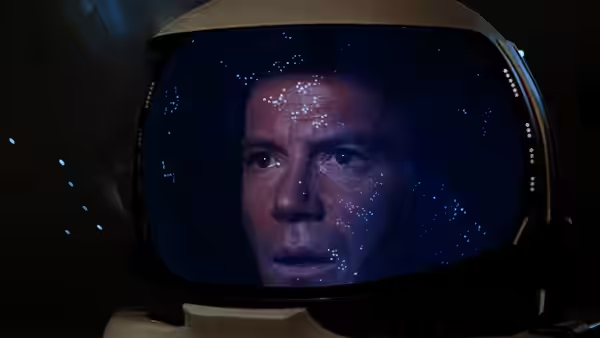
The best thing in it is Jerry Goldsmith. His main theme is a brass march that carries the ship out of dock as if it weighed nothing, and his Klingon cue does more to make them frightening than the make-up does. It earns its keep in the drydock sequence, in which Kirk (William Shatner) and Scotty (James Doohan) ride a pod round the refitted Enterprise while the music climbs. We were moved, because Shatner plays the whole thing in silence and what is on his face is a man looking at the one thing he gave up and wants back.

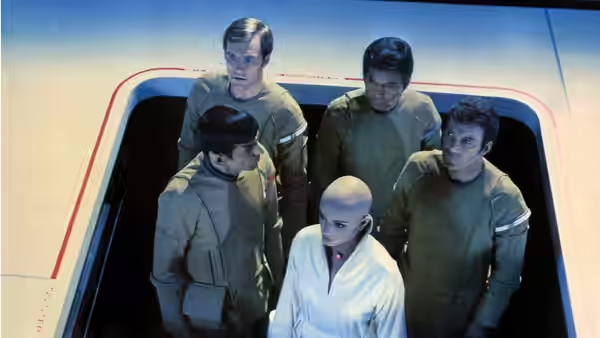
Harold Michelson has built a ship worth circling. The bridge is grey and cream with a sunken well; the recreation deck is the size of a school gymnasium; the engine room has a glowing shaft. Robert Fletcher dresses the crew in beige and pale blue two-pieces with a medical monitor set into the belt buckle, so that Starfleet looks like the staff of an expensive clinic. Richard H. Kline lights it flat and soft, so the corridors resemble an office at three in the afternoon while the space outside the windows has all the colour.

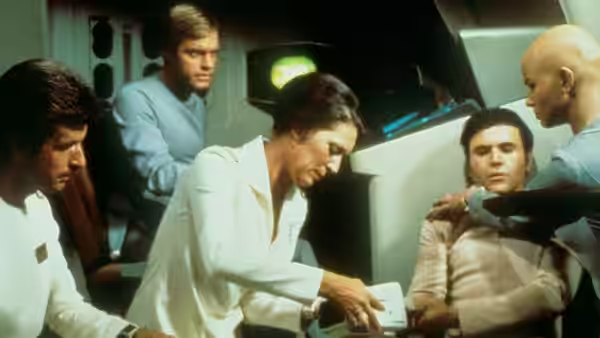
The trouble is Harold Livingston’s script, from a story by Alan Dean Foster, which has a good premise and almost no scenes. Once the ship arrives the pattern sets in: the crew look at the viewscreen, the film cuts to the effects, the crew look again. Todd Ramsay holds each shot of Uhura (Nichelle Nichols) or Sulu (George Takei) staring a beat longer than it can bear, and a reaction shot is not a scene. Chekov (Walter Koenig) is given a burned hand so that something happens. Somewhere inside the cloud we were bored, and then cross about being bored by something so plainly made with care.

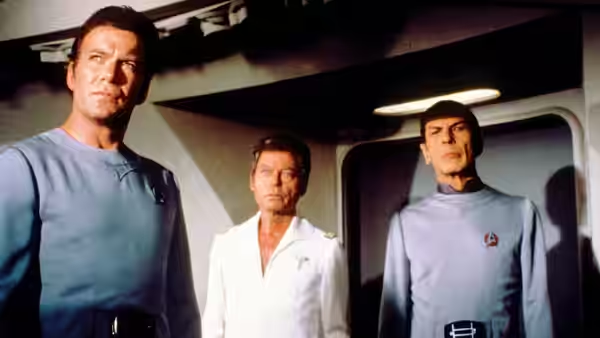
The people fare better than the plot. Shatner plays Kirk as a man who wants his ship back and does not much mind who he moves to get it. Stephen Collins’s Decker is the film’s most interesting human, a capable officer bumped aside by a legend, and he plays the grievance without whining. Persis Khambatta, with her head shaved, gives Ilia a stillness the second half puts to use. Leonard Nimoy arrives an hour in and the film improves at once; the scene in which Kirk and McCoy (DeForest Kelley) greet him at the airlock and get nothing back is the best acted in it. Kelley has the few laughs. Mark Lenard’s Klingon Captain is gone by the end of his one scene.

The second half arrives at an idea we will not describe. It is a better idea than most of the sequels bothered with, and it gives Collins and Khambatta something to play. Wise knows how to hold a frame, but the script has not told the people in it what they are thinking, so the frames stay empty.

Most critics have come round to it, and we half agree. See it if you already know these people; the film assumes you do, and that assumption carries it across the flat stretches. It is rated U. There is a good ninety-minute film in there, and Wise has left us to find it ourselves.
Critical consensus AI synthesised

67
Positive
11
Mixed
1
Negative
2

Most critics come down in its favour, and the warmest reviews are the most recent. Praise clusters on the scale of the thing: Douglas Trumbull’s effects, Jerry Goldsmith’s brassy score and the long, unhurried approach to V’Ger draw admiration across four decades of notices. Several reviews of the restored versions argue that the film’s seriousness, its interest in consciousness and the search for meaning, now looks like a virtue rather than a failure to be fun, and that it plays as a proper 1970s space odyssey.
The reservations cluster almost entirely on pace. Contemporary reviews call it sluggish and talky, and even admirers concede it drags. The spread is wide. The Times calls it possibly the most satisfying film in the franchise; Empire calls it the worst, with effects that look tacky beside Star Wars. The dissenters, Empire and The AV Club among them, mostly want the television series’ charm and do not find it here.

The Times
19 August 2022 · ★★★★☆ · Kevin Maher
90*

The critic argues the film is better than its initial reputation as a plodding sci-fi suggests, calling it possibly the most satisfying in the franchise. They single out the classier existential denouement involving V'ger and the lavishly shot heavy material for praise.

Read the full review →
RogerEbert.com
7 December 1979 · Roger Ebert
70*

The film is a solid, well-made piece of work with an interesting premise about an alien entity seeking its origins, though familiarity with the TV characters somewhat undermines the sense of wonder. It lacks the brilliance of 2001 but delivers an enjoyable ride thanks to strong special effects that improve as the story progresses.

Read the full review →
The Guardian
18 August 2022 · Peter Bradshaw
70*

The critic finds the 4K restoration of the 1979 film watchable and enjoyable for its over-the-top acting and unhurried visionary sequences. They single out the theatrical resonance of the Kirk-Spock-McCoy dialogue scenes and Shatner's distinctive delivery for praise.

Read the full review →
The Hollywood Reporter
7 December 2021 · Arthur Knight
70*

The critic calls the film a big, spectacular epic with strong entertainment values and professional craftsmanship throughout. He praises the visual effects, score, photography and production design while noting some pacing issues and overly talky scenes.

Read the full review →
The New Yorker
10 December 1979 · Roger Angell
70*

It is a medium-range, medium-boring vehicle that is not as inventive as Star Wars or as beautiful as 2001, but there is room for it; the special effects and score create puzzling and awesome travelogues that make the trip enjoyable despite some deficiencies and familiar sci-fi tropes.

Read the full review →
Variety
31 December 1978 · Variety Staff
70*

Producer Roddenberry and director Wise deliver state-of-the-art screen magic with impressive effects under Trumbull and a brassy Goldsmith score that justify the budget; the film makes good use of TV familiarity in a search-and-destroy thriller with philosophical elements, romance, and a twist ending.

Read the full review →

Straight answers AI written, from our review

Is Star Trek: The Motion Picture worth watching?
Star Trek: The Motion Picture is worth watching if you already know these people, and we scored it 64. Jerry Goldsmith's score and Harold Michelson's refitted Enterprise reward the patience it asks for; Harold Livingston's script mostly does not, and the middle hour is people staring at a cloud. Newcomers may find the flat stretches long.
How long is Star Trek: The Motion Picture, and what is it rated?
Star Trek: The Motion Picture runs 2h 11m and is rated G by the MPA in the US. It is a science fiction and adventure film.
Where can I watch Star Trek: The Motion Picture in the US?
Star Trek: The Motion Picture is streaming on Paramount+, The Roku Channel, Hulu and Amazon Prime Video in the US, and it is also available to rent from Amazon Prime Video from $3.99. Availability is checked daily; the links above go straight to each service.
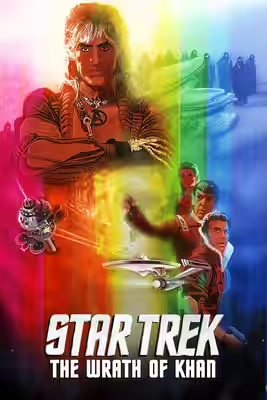
How does Star Trek: The Motion Picture compare to Star Trek II: The Wrath of Khan?
Star Trek: The Motion Picture is the slower and more handsome of the two, and Star Trek II: The Wrath of Khan is the better film. Wise aims for grandeur and asks us to wait; Meyer makes a smaller, tighter picture about growing old, with a villain worth the name. Choose the first for the ship and the music, the second for the people.
Do you need to have seen the other Star Trek films before Star Trek: The Motion Picture?
Star Trek: The Motion Picture is the first of the films and stands alone as a story, but it assumes you already know the crew from the television series. That assumption carries it across its slow stretches, so it is a poor place to start cold. Come to it after the others, or after some television, and the reunion means more.
What should I watch after Star Trek: The Motion Picture?
After Star Trek: The Motion Picture, try 2001: A Space Odyssey (1968, Fi1m 92): The film this one is reaching for, with the nerve to stay strange to the end. Then Solaris (1972, Fi1m 87): Tarkovsky’s slow space station, where the patience is the point and it pays; and Star Trek II: The Wrath of Khan (1982, Fi1m 85): The sequel that found the pulse this film lacks, and kept the people.
What order should I watch the Star Trek films in?
Release order is the safe choice for Star Trek, and it is the order our collection page lists them in. Star Trek: The Motion Picture is the first of the 13 Star Trek titles on Fi1m; after it Star Trek II: The Wrath of Khan. The full order.

Part of · 1 of 13

Star Trek

13 films on Fi1m · 1979–2016 · average 66 · best Star Trek II: The Wrath of Khan 85

All 13 in order

Cast

Awards

Academy Awards, 1980

Nominated
Best Original Score
Nominated
Best Production Design
Nominated
Best Visual Effects

If you liked this, try…

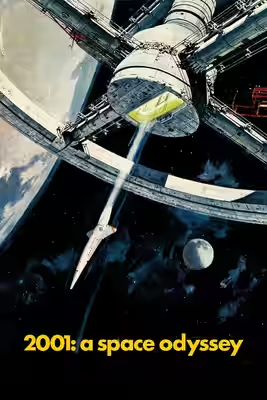
  1. 2001: A Space Odyssey (1968, Fi1m 92)The film this one is reaching for, with the nerve to stay strange to the end.

  2. Solaris (1972, Fi1m 87)Tarkovsky’s slow space station, where the patience is the point and it pays.

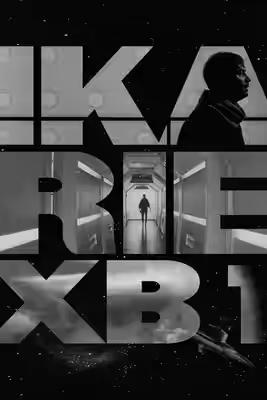
  3. Ikarie XB-1 (1963) · not reviewed yetCzech crew on a long voyage, grey corridors and real dread, decades ahead of its time.

  4. Star Trek II: The Wrath of Khan (1982, Fi1m 85)The sequel that found the pulse this film lacks, and kept the people.

  5. Arrival (2016, Fi1m 86)Another attempt to talk to something enormous, with a script that gives its people scenes.

Free account

Know what to watch tonight

Two lists that know where things are streaming, collections you can share, your own score beside ours, and Discover that remembers what you have seen.

  • Want to see, sorted by what is streaming now
  • Seen, with your score out of ten
  • No adverts, ever