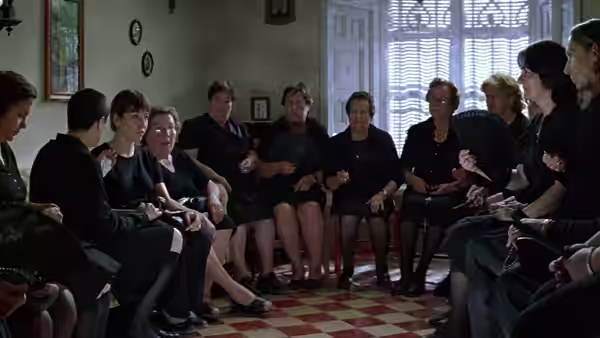
Two women stand in a kitchen, one in a plaid apron, the other with arms crossed
Film review

Volver

2006 · Directed by Pedro Almodóvar · 2h 01m · MPA R

In a sentenceEven a ghost would struggle to get these women to put their feet up

Raimunda (Penélope Cruz) is a working mother whose family has secrets that reach across generations. As violence and the possibility of a ghost enter everyday life, the women around her contend with unfinished business and the work that still needs doing. Carmen Maura plays Irene, Lola Dueñas plays Sole and Blanca Portillo plays Agustina, with Yohana Cobo as Paula and Chus Lampreave as Aunt Paula. Pedro Almodóvar’s comedy-drama follows these women through family obligations, concealed truths and questions about the dead, as they turn to one another for help and consider what they can forgive.

Plays from YouTube when you press play; nothing loads from them until then.

Fi1m review

Pedro Almodóvar’s family melodrama finds humour in hard work and grief, with Penélope Cruz giving its warmth a practical, impatient edge. It occasionally makes forgiveness too comfortable, but we recommend it warmly.

Volver is a warm, funny melodrama that takes the work of looking after a family seriously, and we recommend it with one reservation: Pedro Almodóvar sometimes makes reconciliation come too easily. The women here have plenty to endure, but they also have things to get done, and he gives those demands equal attention. Domestic labour continues alongside violence, secrecy and the possibility of ghosts. The humour comes from the practical response to extraordinary trouble, without pretending that the trouble does not hurt.

Penélope Cruz plays Raimunda with the impatience of someone who cannot afford to stop and examine every feeling. Her care for her daughter is fierce, but Cruz makes the effort of that care visible; the performance never settles for looking maternal. There is humour in her briskness, and strain beneath it, which is why the film can move between comedy and distress without making her seem inconsistent. She keeps Raimunda’s exhaustion present even when the story becomes fanciful.

Carmen Maura’s Irene and Lola Dueñas’s Sole keep the film from becoming a display built around its leading performance. Maura brings an unforced familiarity to the family material, while Dueñas allows uncertainty to complicate the comedy. Blanca Portillo’s Agustina makes us attend to another person’s troubles without wishing we could get back to Raimunda. Almodóvar gives the ensemble time to establish how these women behave with one another, so their willingness to help feels like an existing habit.

José Luis Alcaine’s cinematography gives the colours force without making the domestic work seem less tiring. In the close-up of Cruz singing, Raimunda seems unable to keep her feelings private. We were moved more than we expected. The attention to her face lets us register a vulnerability that her busyness elsewhere keeps hidden. Almodóvar allows the song to take its time, and Cruz makes that time feel necessary.

José Salcedo’s editing handles the movement between domestic comedy and disturbing family material without making the changes feel imposed. The pace slackens as suspense gives way to a slower study of the women, though the actors largely justify that choice. Alberto Iglesias’s music suits the heightened emotions, helping the comic and unsettling passages belong together without requiring the performances to become broader. At 121 minutes, the film allows us to spend time in these women’s company, even when there is less urgency about what happens next.

The difficulty is how readily affection seems able to settle painful questions. Almodóvar’s screenplay gives its women such dependable reserves of mutual help that their differences can feel less troublesome than they ought to be. We can accept coincidence and unlikely events in a family melodrama, but we still want the people involved to be capable of disappointing each other. The film’s kindness occasionally makes those relationships feel arranged for our reassurance.

There is little here for anyone who needs a family drama to behave like a tightly plotted thriller. Give the slower conversations time: the actresses have more to do than keep a secret or get the story moving. See it for Cruz, but give the quieter performances your attention too.

Critical consensus AI synthesised

80
Positive
10
Mixed
0
Negative
1

Most critics respond warmly to Volver, with praise centred on Penélope Cruz’s performance and Almodóvar’s handling of female relationships. The reviews find emotional depth beneath the bright colours and flamboyant premises, particularly in the bonds between mothers and daughters. Cruz is repeatedly singled out for giving Raimunda resilience and feeling, while the ensemble earns recognition beyond its lead. Almodóvar’s ability to combine domestic routine, comedy, tragedy and the supernatural is another recurring strength.

The disagreement concerns how much freshness these familiar themes retain. Slant Magazine admires the craft but notes the limited risks, while Collider finds that the suspense gives way to a slower character study. Sight and Sound is the sharp dissenter, seeing recycled material, idealised sisterhood and too little conflict. The spread is therefore wide, although the prevailing view treats the return to familiar territory as emotionally rewarding rather than tired.

Financial Times
23 August 2006 · ★★★★★ · Nigel Andrews
100

Andrews praises Almodóvar's phenomenal mastery of style and ability to create gleaming coherence from wild premises. He singles out the epiphanic image-making and Cruz's acting, which matches her Sophia Loren-like presence.

Read the full review →
Little White Lies
24 August 2006 · 4/5/4 · Matt Bochenski
100

The critic praises Almodóvar for crafting a fresh, inventive film that mixes genres deftly while returning to his roots in La Mancha and reuniting with Carmen Maura. The performances, especially Penélope Cruz's, and the film's emotional depth beneath its flamboyance are singled out for praise.

Read the full review →
The AV Club
2 November 2006 · A- · Keith Phipps
90

The critic praises Almodóvar’s ability to reveal deeper layers in Cruz beyond her beauty and notes the film’s rich emotional focus on family bonds and color. It singles out a memorable close-up of Cruz singing as emblematic of the director’s artful approach.

Read the full review →
Empire
28 July 2006 · Helen O'Hara
85*

The critic finds Almodóvar on excellent form with a mature, beautifully told tale focused on female relationships and family ghosts. Penélope Cruz delivers a standout performance as the resilient Raimunda amid intricate mother-daughter dynamics.

Read the full review →
Time Out
22 August 2006 · Ben Walters
80*

Almodóvar delivers a fable of domestic drudgery, murder and magic that fuses the hysterical and the mundane with compassion, wit and grace. The director's sophisticated technique and ability to interpolate tragedy and farce are highlighted as strengths.

Read the full review →
Variety
25 March 2006 · festival review · Jonathan Holland
80*

Almodóvar returns to his childhood roots with a low-frills, reflective, and conventional piece that celebrates the pueblo and its people through superbly drawn characters and a straightforward plot. The film is a subdued, sometimes intense and often comic homecoming that showcases Penélope Cruz at her finest.

Read the full review →

Straight answers AI written, from our review

Is Volver worth watching?
Volver is worth watching for anyone who likes a family melodrama with warmth and hard work in it, and we scored it 84. Penélope Cruz gives Raimunda a brisk, impatient care that carries the comedy and the grief together. Our one reservation is that Pedro Almodóvar lets forgiveness arrive too comfortably, so the women rarely disappoint each other.
How long is Volver, and what is it rated?
Volver runs 2h 01m and is rated R by the MPA in the US. It is a comedy and drama film.
Where can I watch Volver in the US?
Volver is available to rent from Amazon Prime Video from $3.99. Availability is checked daily; the links above go straight to each service.
How violent or frightening is Volver, and is it suitable for children?
Volver is rated R in the United States and has no UK certificate listed here, so treat it as a film for adults rather than children. There is violence, family secrets that turn disturbing, and the possibility of a ghost, though the ghost is played for warmth and comedy rather than fright. Teenagers used to adult drama should manage; the squeamish will not need to look away often.
How does Volver compare to Secrets & Lies?
Volver is the warmer and more forgiving of the two films, while Secrets & Lies is the more painful. Both draw humour from family secrets emerging in awkward conversation, but Mike Leigh keeps his people capable of hurting one another, where Almodóvar smooths their differences with affection. Choose Leigh if you want the harder evening, Almodóvar if you want to be moved and comforted.
What should I watch after Volver?
After Volver, try All About My Mother (1999, Fi1m 88): Another Almodóvar family gathers through practical kindness, grief and difficult acts of forgiveness. Then Secrets & Lies (1996, Fi1m 88): Family secrets emerge through awkward conversation, with humour that makes the pain harder to dismiss; and The Farewell (2019, Fi1m 84): Another family negotiates what to conceal, and whom its kindness actually protects.

Cast

Awards

Academy Awards, 2007

Nominated
Best Actress

International Submission to the Academy Awards, 2007

Nominated
International Submission to the Academy Awards

European Film Award for Best Actress, 2006

Won
European Film Award for Best Actress

European Film Award for Best Cinematographer, 2006

Won
European Film Award for Best Cinematographer

European Film Award for Best Composer, 2006

Won
European Film Award for Best Composer

European Film Award for Best Director, 2006

Won
European Film Award for Best Director

European Film Award for Best Film, 2006

Nominated
European Film Award for Best Film

European Film Award for Best Screenwriter, 2006

Nominated
European Film Award for Best Screenwriter

European Film Award – People's Choice Award for Best European Film, 2006

Won
European Film Award – People's Choice Award for Best European Film

If you liked this, try…

  1. All About My Mother (1999, Fi1m 88)Another Almodóvar family gathers through practical kindness, grief and difficult acts of forgiveness.

  2. Secrets & Lies (1996, Fi1m 88)Family secrets emerge through awkward conversation, with humour that makes the pain harder to dismiss.

  3. Our Little Sister (2015) · not reviewed yetSisters build a household together, with more quiet observation and considerably less melodrama.

  4. The Farewell (2019, Fi1m 84)Another family negotiates what to conceal, and whom its kindness actually protects.

  5. A Woman Under the Influence (1974, Fi1m 86)For a harsher account of domestic strain, with an equally absorbing central performance.

Free account

Know what to watch tonight

Two lists that know where things are streaming, collections you can share, your own score beside ours, and Discover that remembers what you have seen.

  • Want to see, sorted by what is streaming now
  • Seen, with your score out of ten
  • No adverts, ever