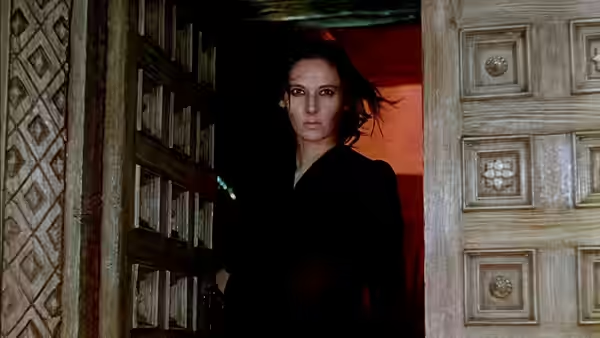
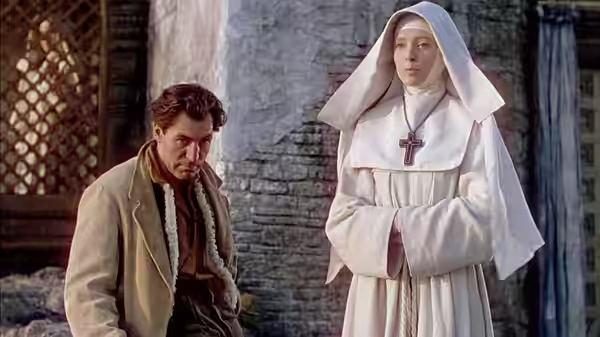
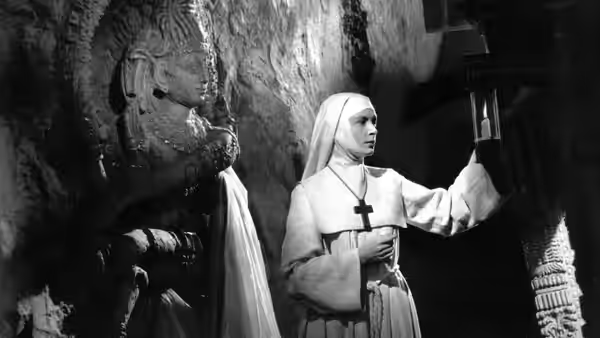
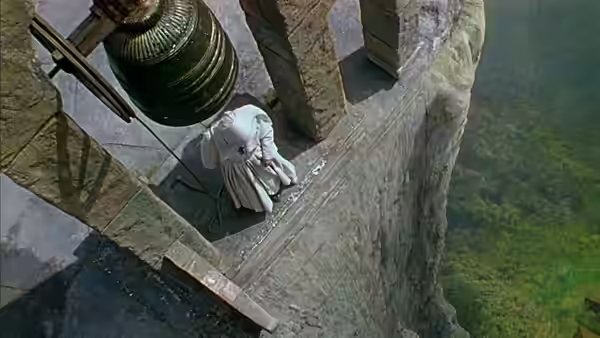
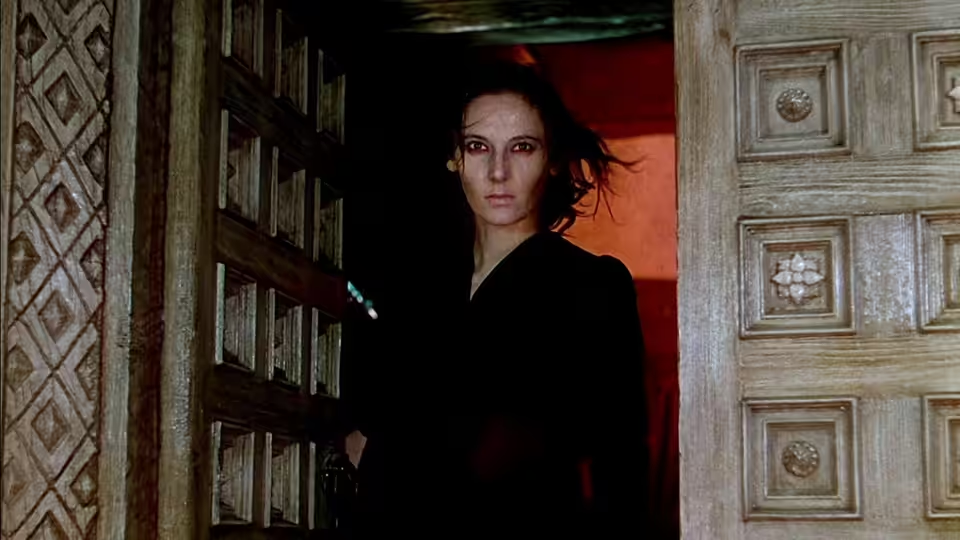
Sister Ruth (Kathleen Byron) standing in a wooden doorway holding an object
Film review

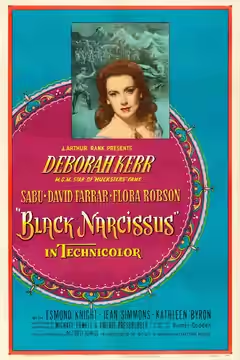
Black Narcissus

1947 · Directed by Emeric Pressburger, Michael Powell · 1h 40m · MPA NR

In a sentenceThe nuns have taken vows; nobody thought to ask the colour scheme

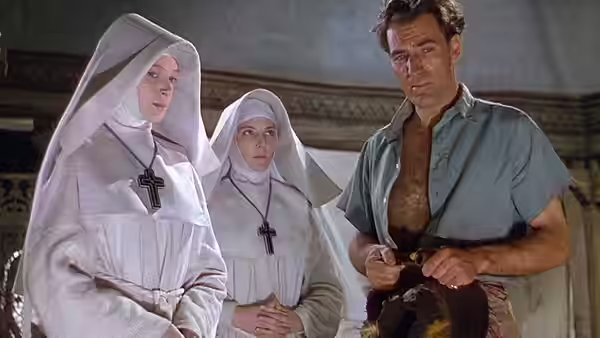
In the Himalayas, Sister Clodagh (Deborah Kerr) tries to keep her attention on her religious duties as the surroundings unsettle a community of English nuns. The presence of Mr. Dean (David Farrar) makes it harder to put worldly feelings aside. Sister Ruth (Kathleen Byron) struggles to contain desires that their religious life gives her little room to express. Mountains surround the women, but their seclusion offers no protection from the strain of living together or their attraction to Mr. Dean. Sister Clodagh wants to preserve her composure and her commitment to her vocation while feelings she cannot control begin to intrude.

Plays from YouTube when you press play; nothing loads from them until then.

Fi1m review

Michael Powell and Emeric Pressburger’s drama of religious repression is sensuous, frightening and worth seeing for its performances alone. Its Himalayan setting sometimes invites an outsider’s simplifications, but the colour and music make the women’s distress hard to dismiss.

Black Narcissus is a gripping melodrama about nuns struggling with desire in the Himalayas. We recommend it warmly, though the women are understood more fully than the place around them. Michael Powell and Emeric Pressburger give religious discipline a difficult test, surrounding it with colour and physical beauty that demand attention. This is an adaptation of a novel by Rumer Godden, but its strongest passages need little explaining. A glance can make a room uncomfortable before anyone has said anything improper.

Deborah Kerr makes Sister Clodagh’s self-control worth watching because it looks like work. The composure is persuasive, but we can see how much effort goes into maintaining it. David Farrar, as Mr. Dean, gives that restraint something bodily and inconvenient to contend with. Their scenes carry an erotic charge without needing explicit action; the attention one person pays to another is enough.

Kathleen Byron works at a more dangerous pitch as Sister Ruth, and her intensity makes good sense beside that controlled performance. We were frightened by her: the hard concentration of her gaze makes even an exchange of looks feel unsafe. This could become a crude division between a sensible woman and a hysterical one, and sometimes the film approaches that simplification. Yet her distress is sufficiently immediate that we cannot comfortably watch her as a problem for somebody else to manage.

Jack Cardiff’s Technicolor photography makes the colour active throughout these encounters. Red draws our eye and keeps desire present even when the women try to contain it; the images would be less troubling if they were less pleasurable to look at. Production designer Alfred Junge’s studio settings and the painted mountain backdrops make a place that seems to press upon the people within it. We can recognise the artifice and still feel the height and isolation, which serves this drama better than geographical accuracy would.

Reginald Mills’s editing gives those looks enough weight for small changes of expression to matter. The scenes feel watchful, as though everyone is noticing more than anyone is prepared to say, and the cutting sustains that discomfort. Brian Easdale’s music makes the suppressed feeling harder to ignore, pushing the drama towards an excess that will divide viewers. We find the insistence largely justified, though occasionally less musical encouragement would let the acting carry more.

The difficulty lies in the treatment of the Himalayan setting, which too readily makes local difference seem like a threat to English composure. There is an awareness of colonial presumption here, but the concentration on the nuns leaves less room for the people around them to be understood on their own terms. The film does not always distinguish between showing the women’s limited understanding and sharing it. That limitation matters, even when the images are doing everything possible to distract us from it.

Religious melodrama can settle for punishing desire or congratulating itself for discovering that believers have bodies. Here, the performances keep returning us to how exhausting it is to monitor every feeling, and the force of the colour and music makes that exhaustion felt. At 100 minutes, it asks for concentrated attention without making a test of endurance. Do not choose it for a quiet evening simply because the central characters are nuns.

Critical consensus AI synthesised

81
Positive
11
Mixed
1
Negative
1

Most critics praise Black Narcissus for making colour, landscape and studio artifice express the desires its characters cannot acknowledge. Jack Cardiff’s Technicolor cinematography, the matte paintings and the sets attract consistent admiration: the reviews see them as essential to the psychological drama, rather than decoration. Praise also clusters around Kathleen Byron’s performance, with Deborah Kerr drawing strong notices, while several critics value the film’s frank treatment of female desire and its attention to cultural tensions.

The disagreement concerns how much of this feverish melodrama the story can sustain. Variety admires the production and colour photography but finds lapses in the storytelling; the Los Angeles Times finds the sexual hysteria and atmosphere excessive. The spread is therefore wide, though the dissent is isolated: most critics regard the heightened emotion and visual intensity as the means by which Powell and Pressburger make repression visible.

Empire
1 January 2014 · William Thomas
90*

The critic calls the film a 1947 masterpiece by Powell and Pressburger. They single out Jack Cardiff’s Oscar-winning Technicolor cinematography and the dramatic matte paintings for praise, noting how the visuals heighten the story of repressed desires.

Read the full review →
Slant Magazine
30 December 2012 · Joseph Jon Lanthier
90*

The critic praises Powell and Pressburger's film as a visually stunning and psychologically complex work, highlighting its erotic undertones, masterful Technicolor cinematography by Jack Cardiff, and empathetic direction that elevates the story of repressed nuns in the Himalayas into a metaphor for artistic vision.

Read the full review →
The AV Club
19 April 2002 · Noel Murray
90*

The critic describes the 1947 Powell-Pressburger film as a rapturous, near-indescribable work of cinematic art that blends spiritual melodrama with abstract emotional resonance through its story of nuns challenged by Himalayan elements and mysticism.

Read the full review →
The Guardian
5 August 2005
90*

The critic urges readers to see this 1947 classic from Michael Powell and Emeric Pressburger on its digitally restored big-screen re-release, calling it an all-time favourite that delivers a sugar-rush of pleasure. They single out the extraordinary melodrama of repressed love and Englishness unravelling in the Himalayas, along with the superb studio sets, convincing backdrops and the magnificent, terrifying performance of Kathleen Byron as Sister Ruth.

Read the full review →
The New Yorker
9 December 2013 · Michael Sragow
90*

This lush 1947 adaptation keeps the screen aglow and the mind agog as a landmark of design and color about faith and temptation. Powell and Pressburger created a rapturous landscape without leaving England.

Read the full review →
The New York Times
14 August 1947
90*

The film is a work of rare pictorial beauty with stunning Technicolor settings and a strong cast led by Deborah Kerr and Kathleen Byron. It is an artistic accomplishment of no small proportions despite potentially disturbing elements.

Read the full review →

Straight answers AI written, from our review

Is Black Narcissus worth watching?
Black Narcissus is worth watching for anyone who can take a melodrama of repression at full pitch, and we scored it 88. Deborah Kerr, David Farrar and especially Kathleen Byron make the strain of monitoring every feeling visible, and Jack Cardiff's Technicolor keeps desire on screen even when the nuns try to contain it. Its treatment of the Himalayan setting is the reservation.
How long is Black Narcissus, and what is it rated?
Black Narcissus runs 1h 40m and is rated NR by the MPA in the US. It is a drama film.
Where can I watch Black Narcissus in the US?
Black Narcissus is streaming on HBO Max, Tubi, Pluto TV, The Roku Channel, Amazon Prime Video and Hulu in the US, and it is also available to rent from Amazon Prime Video from $3.99. It leaves HBO Max on 30 September. Availability is checked daily; the links above go straight to each service.
How does Black Narcissus compare to The Red Shoes?
Black Narcissus is the more frightening of the two, while The Red Shoes is the one we would recommend to almost anyone. Both are Powell and Pressburger films about a disciplined life under pressure from colour, music and consuming desire. The earlier film is tighter and more uncomfortable to watch; the later one is more seductive and easier to enjoy without reservation.
Is Black Narcissus based on a true story or a book?
Black Narcissus is based on a novel by Rumer Godden, not on a true story. The film's strongest passages need little explaining, so knowing the book is not necessary; a glance can make a room uncomfortable before anyone says anything improper. The colour and music do much of the work the prose would otherwise have to do.
What should I watch after Black Narcissus?
After Black Narcissus, try The Red Shoes (1948, Fi1m 92): Another disciplined life comes under pressure from colour, music and consuming desire. Then The Passion of Joan of Arc (1928, Fi1m 94): Faces and close-ups make religious conviction painfully immediate, with little room for comfort; and The Piano (1993, Fi1m 88): Desire, difficult choices and music that says what the characters cannot.

Cast

Awards

Academy Awards, 1948

Won
Best Art Direction, Color
Won
Best Cinematography, Color
Won
Best Production Design

If you liked this, try…

  1. The Red Shoes (1948, Fi1m 92)Another disciplined life comes under pressure from colour, music and consuming desire.

  2. The Passion of Joan of Arc (1928, Fi1m 94)Faces and close-ups make religious conviction painfully immediate, with little room for comfort.

  3. The Devils (1971) · not reviewed yetReligious authority and sexual panic, pushed into a much harsher, more confrontational drama.

  4. The Piano (1993, Fi1m 88)Desire, difficult choices and music that says what the characters cannot.

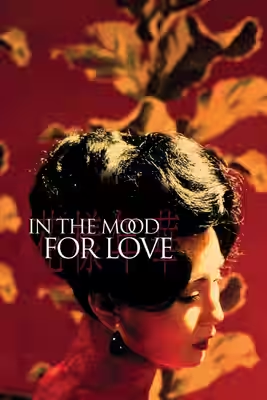
  5. In the Mood for Love (2000, Fi1m 91)For the glances, colours and unbearable effort of keeping desire under control.

Free account

Know what to watch tonight

Two lists that know where things are streaming, collections you can share, your own score beside ours, and Discover that remembers what you have seen.

  • Want to see, sorted by what is streaming now
  • Seen, with your score out of ten
  • No adverts, ever