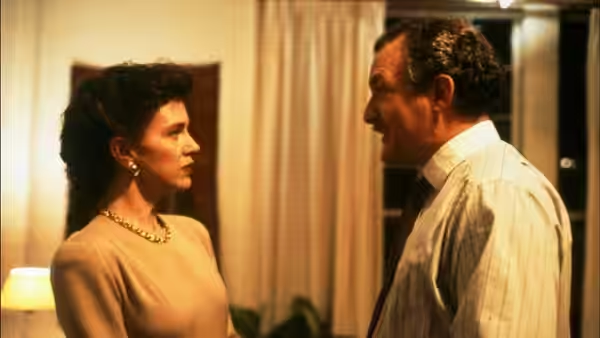
Sally (Judy Davis) and Gabe (Woody Allen) seated facing each other on a couch
Film review

Husbands and Wives

1992 · Directed by Woody Allen · 1h 48m · MPA R

In a sentenceNobody in this marriage comedy needs another explanation, but everyone has one ready

A marriage breaking apart unsettles a circle of New Yorkers who are already unsure about love, sex and the people they live with. Gabe Roth (Woody Allen) and Judy Roth (Mia Farrow) are among those caught up in the questions of staying married and being single. Judy Davis plays Sally, Sydney Pollack plays Jack, and Juliette Lewis plays Rain, with Liam Neeson as Michael Gates. As relationships become tangled, jealousy and insecurity make the prospect of change harder to separate from the wish for reassurance. The comedy follows people trying to understand desires they cannot comfortably reconcile.

Fi1m review

Woody Allen’s abrasive marriage comedy is funny, perceptive and sometimes painful, with Judy Davis giving its anger a human cost. The restless camera occasionally becomes a nuisance, but the performances justify the discomfort.

Husbands and Wives is a sharp, funny marriage comedy whose people can discuss their unhappiness at length without becoming much wiser about it. Writer-director Woody Allen takes the disturbance caused by a marriage breaking apart and watches it spread through other relationships. The fear is recognisable: somebody else’s separation makes staying together begin to look like a decision that might need defending. We recommend it, with a warning that its fidgeting camera can occasionally be as trying as its characters.

Allen plays Gabe Roth and Mia Farrow plays Judy Roth, with Judy Davis as Sally and Sydney Pollack as Jack. The pleasure of the ensemble is that intelligence provides so little protection against jealousy, vanity or panic. Allen’s writing keeps returning to the explanations people offer for wanting what they want, and to how poorly those explanations survive contact with another person’s wishes. He is hard on their self-deception without making their desire for companionship look foolish.

Davis gives the film its most uncomfortable mixture of humour and hurt. Sally’s anger is funny because Davis makes it so exact; it is difficult to dismiss because the distress remains visible underneath. We laughed, then felt mean for laughing. Pollack is equally valuable as Jack, making relationship trouble feel like something happening to an adult who ought to know better. Farrow’s Judy gives the film room for feelings that do not arrive at full volume.

Carlo Di Palma’s handheld cinematography makes these encounters feel difficult to watch from a safe distance. The camera’s restlessness suits people who cannot settle into their own decisions, and the pseudo-documentary approach makes their unhappiness feel uncomfortably exposed. Susan E. Morse’s editing contributes to that abrasive rhythm. It works for much of the film, although there are moments when we would rather be allowed to study a face than keep noticing how insistently the scene is being presented.

Santo Loquasto’s production design keeps the New York setting secondary to the people, a sensible choice when the performances need so little help. The city never becomes a reason to admire their unhappiness as a sophisticated way of living. These people have a considerable appetite for examining relationships, and the film keeps showing how that habit can become another way of avoiding an unwelcome answer. At 108 minutes, it gives their evasions enough time to become exasperating without wearing out our interest.

The larger reservation is that Allen sometimes seems too certain that everyone is deceiving themselves. After a while, we begin waiting for the selfish motive behind every reasonable explanation, and that makes the writing feel less curious about its people. The actors resist that narrowing view by making the need for companionship worth taking seriously. A marriage comedy can be harsh without assuming that anybody who hopes to be happy is an idiot, and this one usually remembers that.

It belongs at the uncomfortable end of marriage comedy, and anyone expecting a soothing evening should take that seriously. Davis and Pollack provide plenty of reason to stay, even when the people they play are difficult company. Watch it with someone who will not treat the conversation afterwards as a cross-examination.


Critical consensus AI synthesised

84
Positive
10
Mixed
1
Negative
0

Most critics rate Husbands and Wives among Woody Allen’s strongest films, and several call it his best since Hannah and Her Sisters. The praise clusters on the ensemble acting, with Judy Davis singled out almost everywhere and Sydney Pollack close behind. The handheld, documentary-style camerawork is the other point of agreement: most reviews find its jerky, raw manner well suited to the characters’ confusion as their marriages come apart. The film itself is read as a study of mid-life panic and jealousy, brutal and funny at once.

The reservations are few and mostly about the same thing. Time Out thinks the handheld camera is occasionally overdone, and The Independent goes further, calling the pseudo-documentary style self-consciously amateurish and asking whether the film works as quiet self-justification given the parallels with Allen’s own life. The New Yorker also finds it uncomfortably personal. That is the only real dissent; the spread is narrow, with one mixed review and none negative.

Empire
1 January 2000 · Mark Honigsbaum
90*

The review describes the black comedy as brimming with poignant exchanges and a triumph as both art and propaganda, praising performances especially from Davis and Pollack while noting its resonance with Allen's personal life makes it one of his best since Hannah and Her Sisters.

Read the full review →
Little White Lies
30 August 2016 · MT
90*

The critic calls it one of Allen’s most mature examinations of relationships in turmoil, noting how the handheld camera and abrasive style convey the characters' emotional bruises while still allowing for rare emotional growth, exemplified in Gabe’s dynamic with Rain.

Read the full review →
RogerEbert.com
18 September 1992 · Roger Ebert
90*

Ebert praises the film as a raw, insightful exploration of the difficulties of marriage and relationships, noting how the characters' rational facades crumble under personal desires. He singles out the jerky, documentary-style handheld camerawork for effectively mirroring the neurotic confusion of the characters.

Read the full review →
Slant Magazine
28 April 2002 · Ed Gonzalez
90*

The critic calls the film a neurotic but universal masterpiece and one of Allen’s most personal and incisive works, cataloging the insecurity and fear that rocks marriages when another breaks apart. He singles out Allen’s paranoiac gaze and understanding of the emotionally fragile period after breakups, including jealousy, the desire to return to ex-lovers, and comfort in loveless constancy.

Read the full review →
Time Out
10 September 2012 · GA
90*

The critic describes the film as an engrossing study of mid-life crisis and tangled relationships, praising its vividly drawn characters and strong performances, especially from Judy Davis and Sydney Pollack. It is called Allen's finest since Hannah and Her Sisters, with minor note that the handheld camera is occasionally overdone.

Read the full review →
Variety
26 August 1992 · Todd McCarthy
90*

McCarthy calls it major Woody Allen, a richly satisfying ensemble piece about neurotics in relationships that stands with his best work like Manhattan. He highlights the radical shift to handheld camerawork and cinema-verite style alongside the strong ensemble acting, especially Judy Davis.

Read the full review →

Straight answers AI written, from our review

Is Husbands and Wives worth watching?
Husbands and Wives is worth watching for anyone who can take a marriage comedy that is sharp, funny and often uncomfortable, and we scored it 83. Judy Davis and Sydney Pollack give the anger and panic a human cost, and Woody Allen's writing is perceptive about self-deception. The fidgeting handheld camera can be as trying as the characters, so this is not a soothing evening.
How long is Husbands and Wives, and what is it rated?
Husbands and Wives runs 1h 48m and is rated R by the MPA in the US. It is a comedy and drama film.
Where can I watch Husbands and Wives in the US?
Husbands and Wives is streaming on The Roku Channel in the US, and it is also available to rent from Amazon Prime Video from $3.99. It leaves The Roku Channel on 1 October. Availability is checked daily; the links above go straight to each service.
How violent or frightening is Husbands and Wives, and is it suitable for children?
Husbands and Wives contains no violence and nothing frightening, but it is an adult comedy about marriages breaking apart, rated R in the United States and unclassified in the UK. Its discomfort comes from jealousy, anger and frank talk about sex and unhappiness rather than anything shown on screen. It is aimed at adults and holds little for children.
What should I watch after Husbands and Wives?
After Husbands and Wives, try A Separation (2011, Fi1m 93): Another marriage under pressure, with each person’s reasonable position making compromise harder. Then 45 Years (2015, Fi1m 88): A quieter study of marriage, where small reactions make a shared history feel uncertain; and The Squid and the Whale (2005, Fi1m 83): For family breakdown seen through the damage articulate adults do to children.

Cast

Awards

Academy Awards, 1993

Nominated
Best Supporting Actress
Nominated
Best Writing, Original Screenplay

If you liked this, try…

  1. Scenes from a Marriage (1973) · not reviewed yetFor another unsparing account of intimacy, resentment and the work of staying together.

  2. A Separation (2011, Fi1m 93)Another marriage under pressure, with each person’s reasonable position making compromise harder.

  3. 45 Years (2015, Fi1m 88)A quieter study of marriage, where small reactions make a shared history feel uncertain.

  4. The Squid and the Whale (2005, Fi1m 83)For family breakdown seen through the damage articulate adults do to children.

  5. An Unmarried Woman (1978, Fi1m 82)For another New York woman discovering what remains when a marriage ends.

Free account

Know what to watch tonight

Two lists that know where things are streaming, collections you can share, your own score beside ours, and Discover that remembers what you have seen.

  • Want to see, sorted by what is streaming now
  • Seen, with your score out of ten
  • No adverts, ever