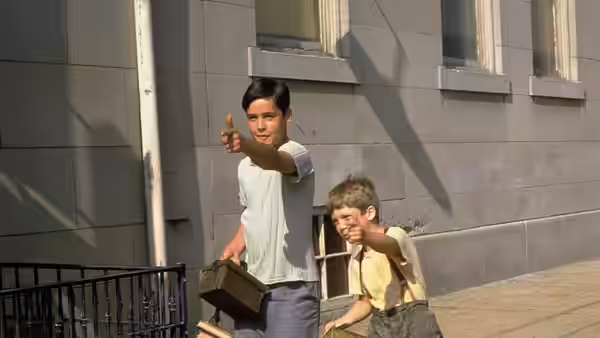
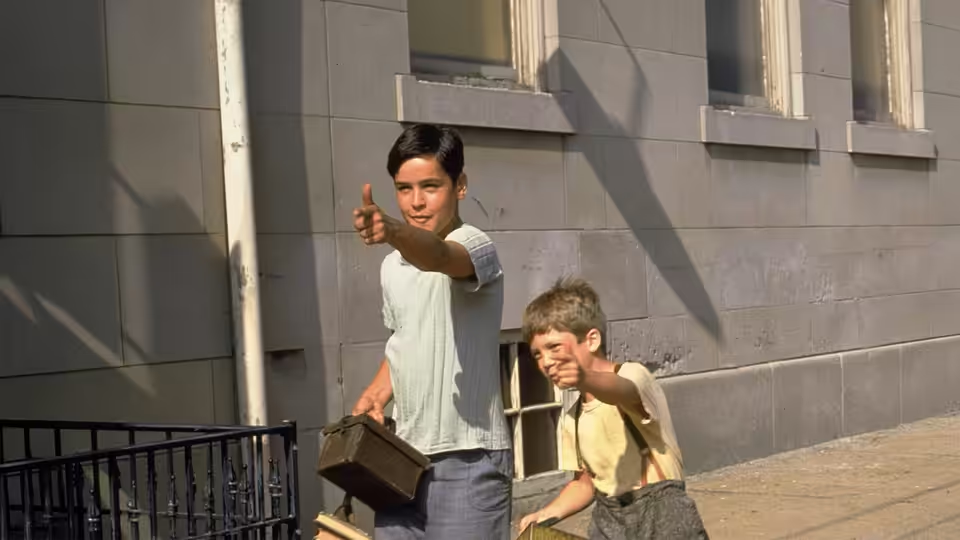
Two boys point ahead while holding suitcases outside a stone building
Film review

King of the Hill

1993 · Directed by Steven Soderbergh · 1h 43m · MPA PG-13

In a sentenceNobody in this hotel can pay the bill, and the boy at the end of the corridor is the best liar in the building

St Louis, the Depression. Aaron Kurlander (Jesse Bradford) lives with his parents and his younger brother Sullivan (Cameron Boyd) in a residential hotel where the rent is always late. One by one the family goes: Sullivan is sent to relatives, Mrs Kurlander (Lisa Eichhorn) is taken to a sanatorium, and Mr Kurlander (Jeroen Krabbé), a watch salesman, takes a job that keeps him away. Aaron stays behind, tells his classmates a grander story than the truth, and gets by on his wits and the company of the hotel’s other residents: Lydia (Elizabeth McGovern), the older boy Lester (Adrien Brody) and his teacher Miss Mathey (Karen Allen). Steven Soderbergh adapts A. E. Hotchner’s memoir.

Fi1m review

Soderbergh’s third film leaves a boy alone in a Depression hotel and trusts Jesse Bradford to carry it, which he does without strain. The last half hour tidies up more than it should; everything before it is the best of his early work.

Aaron Kurlander (Jesse Bradford) lives with his parents and his younger brother in a residential hotel in St Louis, in the middle of the Depression, and the family goes one person at a time. Sullivan (Cameron Boyd) is sent to relatives because there is one mouth too many. Mrs Kurlander (Lisa Eichhorn) is taken to a sanatorium. Mr Kurlander (Jeroen Krabbé), who sells watches nobody can afford, finally gets a proper job, and the job is out of town. Aaron is left behind with a key, a promise that someone will be back soon, and no money. Steven Soderbergh’s third film, from A. E. Hotchner’s memoir, is the best thing he had made to that point, and we recommend it warmly, with one caveat about its last half hour.

Aaron’s answer to all of this is to lie. He tells his classmates his family has money, and the lies grow as the money shrinks. Bradford plays him watchful and quick, a boy who has worked out that adults believe a confident child, and he never once asks us to feel sorry for him. That is why the scene that got us works as well as it does. Alone in the hotel room, past the point of hunger, Aaron cuts pictures of food out of a magazine, arranges them on a plate, and eats them with a knife and fork, in the right order. Soderbergh holds on it without music. We were not ready for it, and we sat with it for some time afterwards.

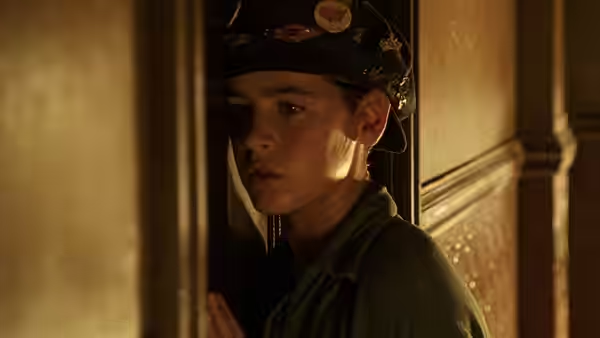
Elliot Davis shoots the hotel in a thick amber light, curtains glowing, dust in the air, and for the first half hour you could mistake it for nostalgia. It is not. As the rooms empty the light stays warm and the faces in it get thinner, and the contrast does the work a speech would have done in another film. Gary Frutkoff’s hotel is precise about money: a corridor of doors with a padlock appearing on one, then another. Susan Lyall keeps Aaron in the same shirt long enough that you start to notice the collar. Cliff Martinez’s score is small and quick and stays out of the worst scenes altogether. Soderbergh edits his own film and cuts most scenes a beat before you expect, which stops the sentiment settling.

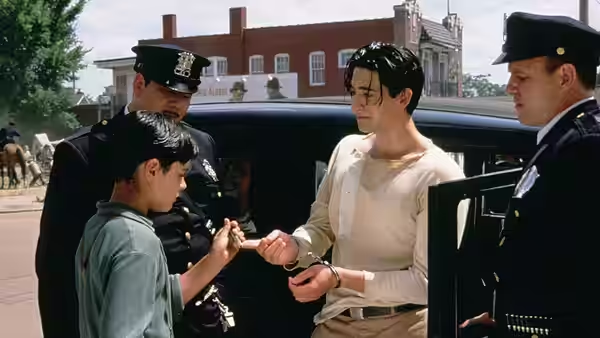
The other guests show Aaron every way there is to be broke. Mr Mungo, down the corridor, has a good suit, good manners and a bottle. Elizabeth McGovern’s Lydia is kind to Aaron in a way that comes with terms. Adrien Brody’s Lester, a few years older, has already learned how the city works and passes some of it on. Karen Allen’s Miss Mathey is the one adult who looks at Aaron and sees a child rather than a problem. Joe Chrest’s Ben, the bellhop, and John McConnell’s Patrolman Burns are the hotel’s two kinds of authority, and neither is on Aaron’s side. Amber Benson’s Ella McShane, across the hall, has a mother (Kristin Griffith) who knows exactly how close her own family is to the same edge.

Some of these people are one note, and the film knows it; they are there to show Aaron a possible future and then go. What we hold against it is the last stretch, where misfortune arrives in a queue, and then a resolution tidier than anything before it has earned. Krabbé’s father is written soft, too, and the film forgives him more readily than we did. One dissenting review took the changes of tone as a sign the film could not make up its mind. We think they are the point. A child in that room does not get to choose between a funny day and a frightening one.

After sex, lies, and videotape and Kafka, this was the first time Soderbergh pointed the camera at people rather than at an idea, and it turned out he was good at it. He has made bigger and colder films since. He has rarely made a warmer one.

It runs 103 minutes and does not feel like it. Watch it with something to eat within reach. You will want it.

Critical consensus AI synthesised

78
Positive
6
Mixed
1
Negative
0

The reviews for King of the Hill are warm and closely grouped, with a single dissenter. Most critics treat Soderbergh’s third film as an early sign of how well he writes and builds a scene: the praise gathers around the screenplay, which makes a shape out of anecdotal memoir material, and around the film’s steady, unsentimental view of Depression-era poverty as seen through a boy’s eyes. Bradford’s performance is singled out repeatedly for its watchfulness and resilience, and several critics admire how the film moves between light and heartbreaking moments without settling into nostalgia. Time Out concedes the coming-of-age story holds few surprises but finds the film’s sensitivity carries it.

The one reservation of substance comes from The Independent, which argues that the frequent shifts in tone read as indecision rather than complexity, the very quality others count as the film’s strength. The later reappraisals are, if anything, warmer than the 1993 notices.

The AV Club
5 March 2014 · A- · Mike D'Angelo
90

The review praises Soderbergh’s third film as evidence of his strong screenwriting skills, highlighting its expertly crafted screenplay and the illusion of order created from anecdotal source material. It singles out the child protagonist’s resilient, watchful performance and the film’s balanced mix of lighthearted and heartbreaking moments.

Read the full review →
Los Angeles Times
20 August 1993 · Michael Wilmington
85*

The review calls it one of the finest American films of the year for its mingled apprehension and delight in depicting a boy's resilience. Soderbergh is praised for brilliantly recreating the world of the Depression-era memoir.

Read the full review →
Slant Magazine
24 February 2014 · Chuck Bowen
85*

The review lauds the film as a key early Soderbergh work that receives worthy Criterion treatment, commending its lucid pragmatism and resistance to unearned sentiment. It singles out the child’s-eye view of Depression-era hardship, the push-and-pull tone, and the precise formal construction of key sequences like the hallucination scene.

Read the full review →
The New York Times
20 August 1993 · Janet Maslin
80*

The critic praises the film for capturing the precariousness of life during the Depression with warmth and wit, without nostalgia. Soderbergh is singled out for turning a moment of hunger into something buoyant and defying expectations.

Read the full review →
Variety
20 May 1993 · festival review · Todd McCarthy
80*

The film is hailed for its rich satisfactions as a fine novel, with dense detail and superb acting evoking a boy's Depression life. Soderbergh is noted for animating another time while underlining parallels to contemporary struggles.

Read the full review →
The Independent
23 December 1993
45*

The film mixes period nostalgia for the Thirties with childhood warmth but includes a dark streak. Frequent shifts in tone make it feel indecisive rather than complex.

Read the full review →

Straight answers AI written, from our review

Is King of the Hill worth watching?
King of the Hill is worth watching, and we scored it 84: a warm, precise Depression drama about a boy left alone in a St Louis hotel, carried without strain by the young Jesse Bradford. Our one reservation is the last half hour, where misfortune arrives in a queue and the ending tidies up more than the film has earned.
How long is King of the Hill, and what is it rated?
King of the Hill runs 1h 43m and is rated PG-13 by the MPA in the US. It is a drama and history film.
Where can I watch King of the Hill in the US?
King of the Hill is not on any streaming or rental service in the US at the moment. It is available in 3 other countries; change your country at the top of the page to see where. Availability is checked daily.
How does King of the Hill compare to The Florida Project?
King of the Hill and The Florida Project are both childhoods spent in a hotel on the edge of eviction, but they are different in kind. Baker's film stays at a six-year-old's height and is funnier and rawer; Soderbergh's follows an older, cannier boy and is warmer and more shaped, with a softer ending. We think the earlier film is the tidier and more conventionally satisfying, the later one the harder to shake.
Is King of the Hill based on a true story or a book?
King of the Hill is based on a true story: Steven Soderbergh adapts A. E. Hotchner's memoir of his own boyhood in a St Louis hotel during the Depression. Our review does not weigh how closely the film keeps to the book, and you do not need to have read it; the film stands entirely on its own.
What should I watch after King of the Hill?
After King of the Hill, try Paper Moon (1973, Fi1m 86): Another Depression child who lies for a living, and a father figure who is worse at it. Then Nobody Knows (2004, Fi1m 87): Four Tokyo children left in a flat by their mother; Kore-eda watches and does not flinch; and The Florida Project (2017, Fi1m 88): A motel childhood in the shadow of Disney World, seen entirely at a six-year-old’s height.

Cast

If you liked this, try…

  1. Paper Moon (1973, Fi1m 86)Another Depression child who lies for a living, and a father figure who is worse at it.

  2. Nobody Knows (2004, Fi1m 87)Four Tokyo children left in a flat by their mother; Kore-eda watches and does not flinch.

  3. The Florida Project (2017, Fi1m 88)A motel childhood in the shadow of Disney World, seen entirely at a six-year-old’s height.

  4. Hope and Glory (1987, Fi1m 82)Boorman’s Blitz boyhood, where catastrophe for the grown-ups is the best summer of your life.

  5. Bicycle Thieves (1948, Fi1m 93)A father, a son and a stolen bicycle in postwar Rome; poverty filmed without pity.

Free account

Know what to watch tonight

Two lists that know where things are streaming, collections you can share, your own score beside ours, and Discover that remembers what you have seen.

  • Want to see, sorted by what is streaming now
  • Seen, with your score out of ten
  • No adverts, ever