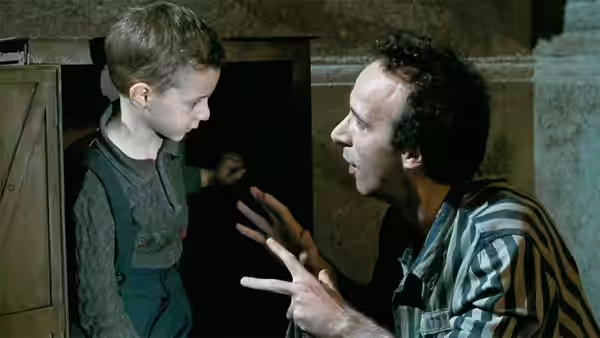
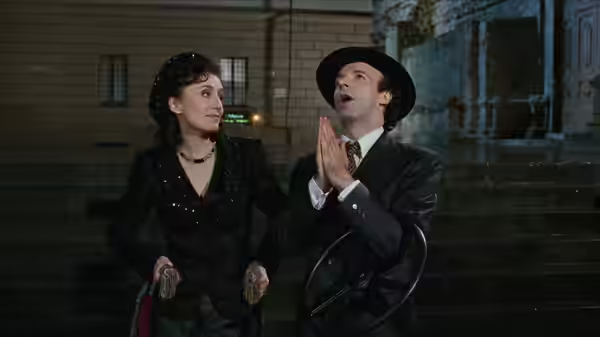
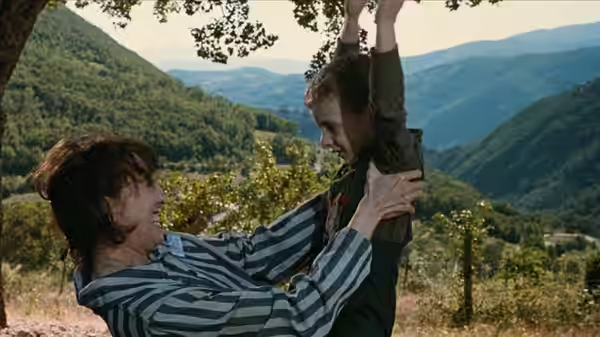
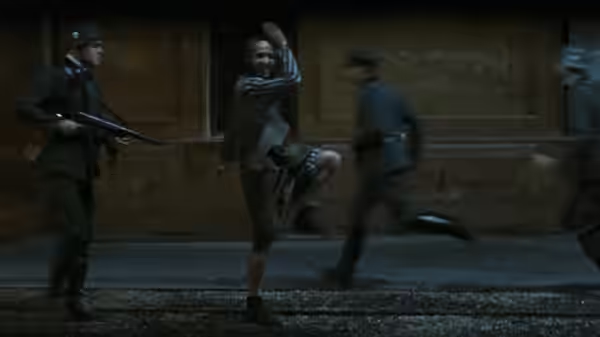
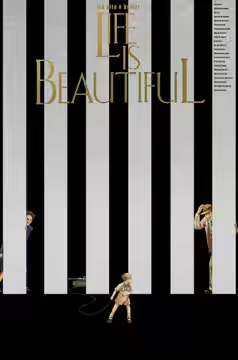
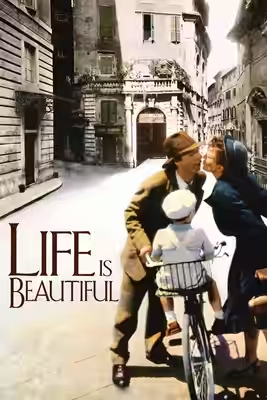
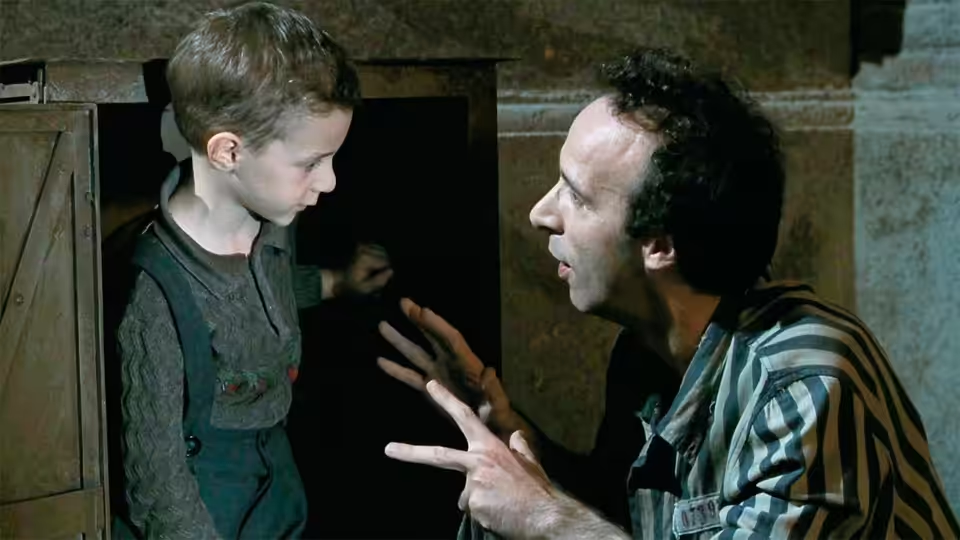
Guido (Roberto Benigni) gesturing to Giosué (Giorgio Cantarini) in a dark doorway
Film review

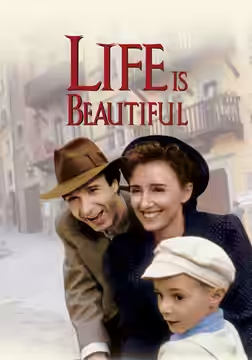
Life Is Beautiful

1997 · Directed by Roberto Benigni · 1h 56m · MPA PG-13

In a sentenceA father works so hard to protect his child that the film starts protecting the audience too

In 1939 Italy, Guido (Roberto Benigni) courts Dora (Nicoletta Braschi) with jokes and elaborate romantic inventions. Their courtship opens a story about a family facing the Holocaust, with Giorgio Cantarini playing Giosué, the son Guido tries to protect from the terror around them. Guido’s habit of turning life into comedy becomes central to his efforts to shield the child from what adults understand. Benigni directs and co-writes the screenplay with Vincenzo Cerami; the cast also includes Giustino Durano as Zio and Horst Buchholz as Doctor Lessing.

Fi1m review

Roberto Benigni’s romance is funny, and his anxious father can be deeply moving. But Life Is Beautiful softens its Holocaust setting too much to make its reassurance convincing.

Roberto Benigni sets Life Is Beautiful a difficult task: to make a father’s comic imagination matter in a story about the Holocaust. The result is funny and affecting in places, but its determination to reassure us becomes a serious weakness. Benigni wants us to understand why a parent might keep performing when there is no longer anything to laugh about. We believe in that impulse, though the film gives us too little reason to question what it can accomplish.

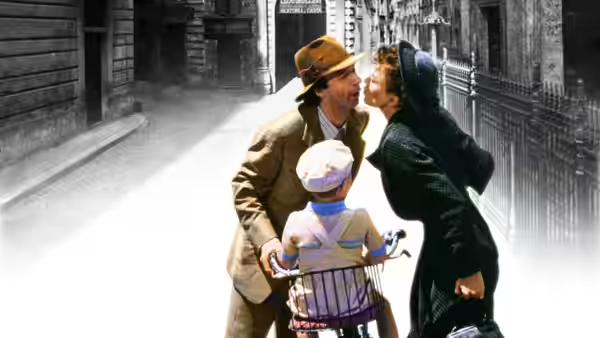
The courtship gives Benigni’s Guido ample opportunity to be ridiculous, and he takes it. His physical comedy makes romantic persistence seem like strenuous work, with Dora, played by Nicoletta Braschi, providing the reason he will not stop. We laughed at the extravagance of his attempts to win her over, because Benigni throws himself into each invention with so little apparent embarrassment. This is the stretch in which the film’s confidence feels justified, and its affection for Guido is easiest to share.

The screenplay, by Benigni and Vincenzo Cerami, asks the same ingenuity to sustain much harsher material. There is a clear connection between the lover who invents ways to woo Dora and the father who tries to protect Giosué. The writing does not make that connection sufficient to hold the film together. It keeps returning to Guido’s resourcefulness when we need a stronger sense of what lies beyond his control, and the repeated encouragement to admire him becomes wearing.

Tonino Delli Colli’s cinematography contributes to the difficulty by making horror too pleasing to contemplate. The images encourage us to appreciate their arrangement when we ought to be troubled by what they contain. Danilo Donati’s production design is more convincing during the courtship, where surroundings that feel arranged for Guido’s inventions suit the comedy. Beyond the romance, that continued sense of accommodation makes the danger harder to believe.

Benigni’s performance is more persuasive when the effort begins to show. We were moved by Guido’s determination to keep his son from recognising his fear; the strain of continuing to be funny gives the clowning a purpose we can understand. Giorgio Cantarini plays Giosué, and the father’s need to protect this particular child gives the story something immediate to care about. These moments are strong enough to explain the affection the film inspires, even when its larger choices remain hard to accept.

Simona Paggi’s editing leaves the two parts awkwardly joined, and some of the comedy lingers after its initial pleasure has faded. The pacing gives us time to notice how much work Benigni is doing to keep everything connected. Nicola Piovani’s music encourages tenderness, which is welcome during the romance and less helpful when the film needs to give us room for discomfort. Its emotional prompting becomes another reason to feel that our response is being decided for us.

A comic fable can ask us to accept coincidences and an improbably resourceful hero. With the Holocaust as its subject, it also has to persuade us that suffering has not been made easier to digest for our benefit. Benigni’s sincerity cannot quite settle that concern, however much his performance earns our sympathy. See it for Benigni, provided you are willing to leave with more doubts than the film seems to anticipate.

Critical consensus AI synthesised

59
Positive
3
Mixed
1
Negative
2

The reviews are sharply divided over Life Is Beautiful, with praise clustering around Benigni’s clowning, the early romance and his performance as a father trying to protect his child. Admirers find his energy and tenderness persuasive enough to carry the shift from romantic comedy to Holocaust horror. For these critics, the invented game preserves a child’s innocence without concealing the terror around him, giving the film both humour and emotional force.

The disagreement concerns the treatment of the camps, not simply whether the jokes work. The Guardian finds the sentimentality gravely misjudged, while The New Yorker argues that the film offers reassurance where it should disturb. Variety occupies a more qualified position, praising Benigni’s depth as a father but finding the writing, editing and connection between the two halves weak. The spread is wide: what supporters find moving, detractors regard as a comforting distortion.

Empire
1 January 2000 · Caroline Westbrook
85*

The critic praises Benigni for crafting a remarkable film that finds laughs in a concentration camp setting while maintaining emotional power comparable to Schindler's List. They highlight the inventiveness, energy, and focus on the romance between the leads.

Read the full review →
The AV Club
29 March 2002 · Joshua Klein
85*

The critic praises Benigni's daring blend of humor and Holocaust horror, noting the film's ability to capture the surreal evil through laughter while protecting a child's innocence. The review highlights the powerful, realistic distinction between the invented game and the camps' terror as moving and amazing.

Read the full review →
The Guardian
12 February 1999 · Jonathan Romney
20*

The critic finds Benigni's comedy sincere but horribly misjudged, presenting the Holocaust as a gently touching tragedy with a happy ending. He singles out the aestheticized image of a mound of dead bodies as the most unthinkingly kitsch moment in cinema.

Read the full review →
The New Yorker
15 March 1999 · Anthony Lane
20*

The critic finds the film soothing and anodyne but ultimately one of the most unconvincing and self-congratulatory movies ever made, arguing it functions as a benign form of Holocaust denial that lets audiences feel relieved. It singles out the use of comedy and art to supposedly save lives as unpersuasive.

Read the full review →
Los Angeles Times
23 October 1998 · Kenneth Turan

The critic acknowledges the film's mixed reaction and tough premise but notes that it succeeds better than expected with genuine poignancy, pathos, and sincerity from Benigni's infectious energy and innocence. It singles out the elaborate game conceit in the camp and the balance between sentiment and the human spirit's triumph.

Read the full review →
Sight and Sound
· Colin MacCabe

Benigni's film attempts the impossible by making a comedy out of the Holocaust and affirming society amid its destruction. It excels in the first hour's romance and Benigni's clowning while recognising the enormity of representing the camps.

Read the full review →

Straight answers AI written, from our review

Is Life Is Beautiful worth watching?
Life Is Beautiful is worth watching for Roberto Benigni's performance as an anxious, clowning father, and we scored it 65. The courtship is funny and Guido's strain to keep his son from seeing his fear is moving, but the film softens its Holocaust setting too much for its reassurance to convince. Expect to leave with more doubts than it seems to anticipate.
How long is Life Is Beautiful, and what is it rated?
Life Is Beautiful runs 1h 56m and is rated PG-13 by the MPA in the US. It is a comedy and drama film.
Where can I watch Life Is Beautiful in the US?
Life Is Beautiful is streaming on The Roku Channel, Amazon Prime Video and Apple TV in the US, and it is also available to rent from Amazon Prime Video and Apple TV from $4.99. Availability is checked daily; the links above go straight to each service.
How does Life Is Beautiful compare to The Great Dictator?
Life Is Beautiful and The Great Dictator both use physical comedy against fascism, but Chaplin's film is the angrier and the sharper of the two. Benigni's fable keeps reassuring us and makes its horror too pleasing to look at, while Chaplin picks clearer targets and offers less comfort. Chaplin's is looser and longer; Benigni's is warmer and easier to trust less.
What should I watch after Life Is Beautiful?
After Life Is Beautiful, try The Great Dictator (1940, Fi1m 80): Chaplin’s physical comedy confronts tyranny with sharper targets and less reassurance. Then The Shop on the High Street (1965, Fi1m 90): Comedy curdles under fascism, with greater attention to compromised ordinary people; and Au revoir les enfants (1987, Fi1m 90): A child’s view of persecution, handled with restraint and accumulating dread.

Cast

Awards

Academy Awards, 1999

Nominated
Best Film Editing
Nominated
Best Picture
Nominated
Best Writing, Original Screenplay
Won
Best Actor
Won
Best International Feature Film
Won
Best Original Dramatic Score

International Submission to the Academy Awards, 1999

Nominated
International Submission to the Academy Awards

Cannes Film Festival, 1998

Won
Cannes Film Festival Grand Prix

European Film Award for Best Actor, 1998

Won
European Film Award for Best Actor

European Film Award for Best Film, 1998

Won
European Film Award for Best Film

If you liked this, try…

  1. The Great Dictator (1940, Fi1m 80)Chaplin’s physical comedy confronts tyranny with sharper targets and less reassurance.

  2. The Shop on the High Street (1965, Fi1m 90)Comedy curdles under fascism, with greater attention to compromised ordinary people.

  3. Au revoir les enfants (1987, Fi1m 90)A child’s view of persecution, handled with restraint and accumulating dread.

  4. Good Bye, Lenin! (2003, Fi1m 78)Another protective family deception, with humour that allows room for doubt.

  5. Boy (2010) · not reviewed yetA child’s imagination makes an unreliable father funny, then painfully recognisable.

Free account

Know what to watch tonight

Two lists that know where things are streaming, collections you can share, your own score beside ours, and Discover that remembers what you have seen.

  • Want to see, sorted by what is streaming now
  • Seen, with your score out of ten
  • No adverts, ever