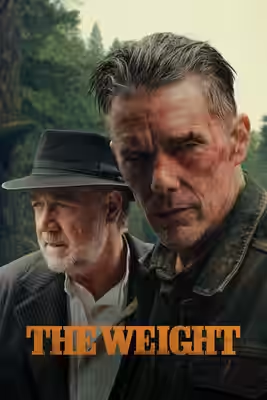
Padraic McKinley’s debut is a plain, wet, old-fashioned adventure about men carrying gold through a forest, and Ethan Hawke, saying almost nothing, holds it together. The script gives him too little company, and the ending gives him too easy a road.
Padraic McKinley’s first film as director sends a party of prisoners into the Oregon woods in the 1930s with stolen gold on their backs, and it does not pretend to be anything cleverer than that. It is a survival picture of the kind American studios made in the 1970s and then largely stopped making: men, weather, weight, and a long way to go. For most of its 112 minutes it is decent, honest work, and for two or three sequences it is a good deal more. What it lacks is people other than Ethan Hawke, and, at the last, the nerve to follow its own logic.
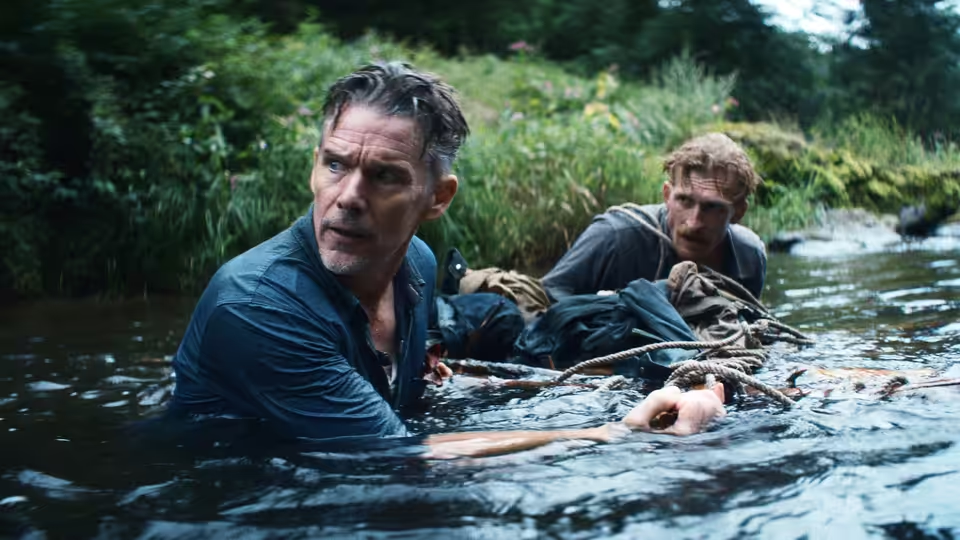
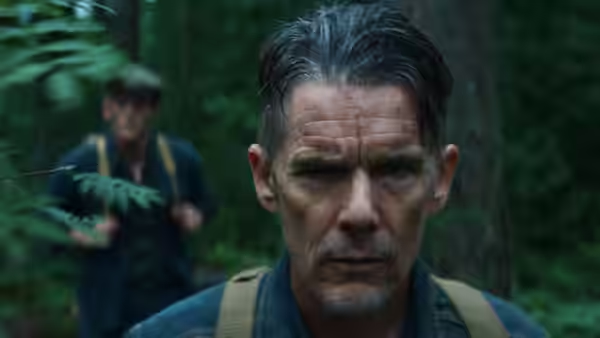
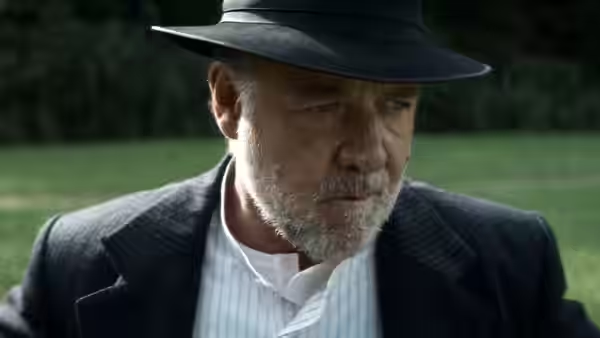
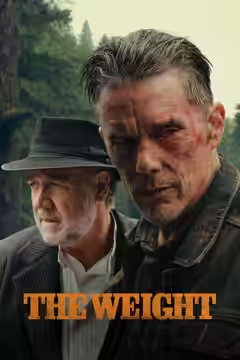
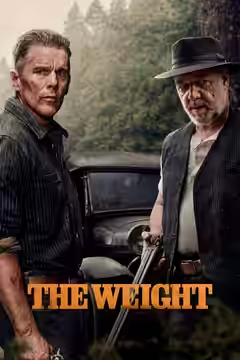
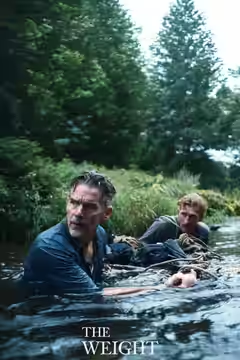
Hawke plays Samuel Murphy as a man who has given up on talking. He walks, he lifts, he watches, and when he does speak it is usually to say the thing that needs doing next. It is a performance built from the shoulders down, and the film has the sense to let him carry it; there are long stretches in which nobody says a word and we knew exactly what Murphy was thinking. Russell Crowe’s Warden Clancy is the opposite proposition, heavy, genial and pleased with himself, a man who has worked out how to make a prison pay. Crowe is good value in every scene he is given, and he is not given enough of them.
The craft is the film’s strongest suit. Matteo Cocco shoots the forest in flat grey daylight with the colour drained out of it, so that the gold, when it appears, is the only warm thing in the frame, and he keeps the camera low and close when the men are climbing, so we feel the gradient in our own legs. Cora Pratz’s production design is mud, tarpaulin and split timber, and Esther Walz dresses the prisoners in wool that gets visibly heavier as it soaks. The score by Shelby Gaines and Latham Gaines is mostly low strings and percussion that sounds like tools being struck, and in the set pieces it does a good deal of the work the script has not.
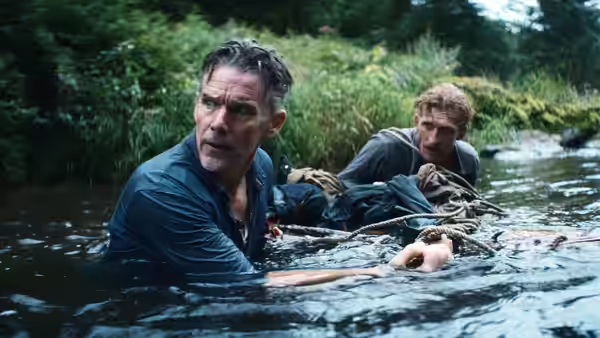
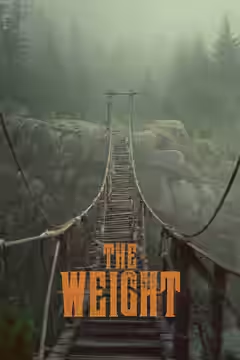
The rope bridge is the sequence we will remember. A crossing that should take a minute takes far longer, the gold is the problem, and McKinley holds on the ropes rather than the faces, so that we found ourselves leaning forward with our jaws set, willing a knot to hold. It is done with rope, water and men, with no computer evident anywhere, and it is the best staging in the film. There is a river later that comes close. The film is at its best when it stops talking and gives its people something to lift.
The trouble is what happens between the lifting. Matthew Booi and Shelby Gaines’s screenplay gives the other prisoners one trait apiece and leaves them there; Rankin (Austin Amelio), Singh (Avi Nash), Olson (Lucas Lynggaard Tønnesen) and Amis (Sam Hazeldine) are distinguishable mostly by hat. They talk at night around fires, and the talk is the kind you have heard in every film of this type, about what a man would do with his share. Julia Jones, as Anna, gets a handful of scenes and makes more of them than they deserve. Somewhere past the hour, between two set pieces, we were bored, and it was the particular boredom of knowing which man would fail next and roughly when.
McKinley cut the film himself, with Matthew Woolley, and it shows in both directions. The set pieces are edited with patience; the walking between them is edited with too much, so the middle third of the journey feels longer than the miles could justify. And the last ten minutes take the kinder road when everything before them has argued for the harder one. We will not say how. We will say we left feeling let off rather than released.
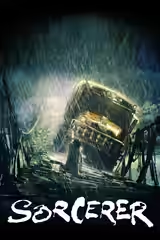
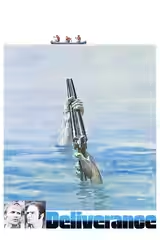
William Friedkin’s Sorcerer (1977) and John Boorman’s Deliverance (1972) are the films most critics have reached for, and the comparison is fair on the wilderness and unfair on the people. Both of those films knew who was in the boat. The Weight knows Murphy. The others are cargo.
It carries a 15 certificate. See it on a large screen if you can, because the forest and the score are most of the point, and take someone who does not mind quiet. Then argue on the way home about whether the ending spoiled it. We think it nearly did.