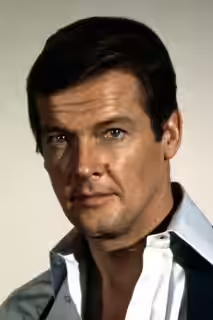
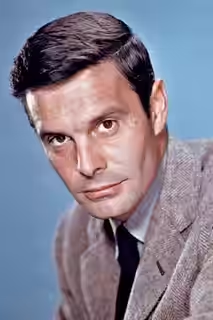
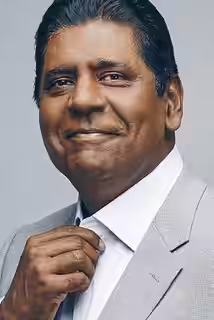
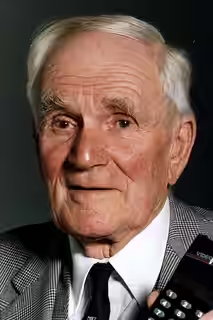
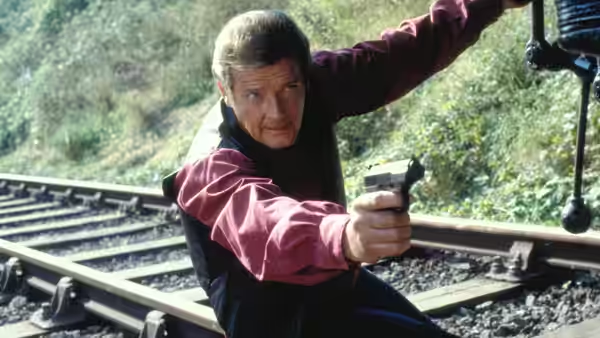
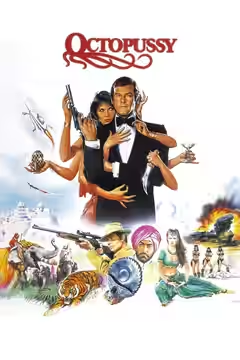
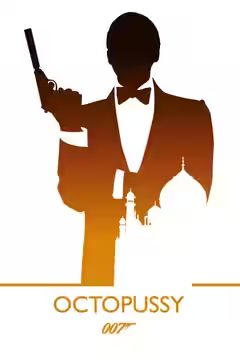
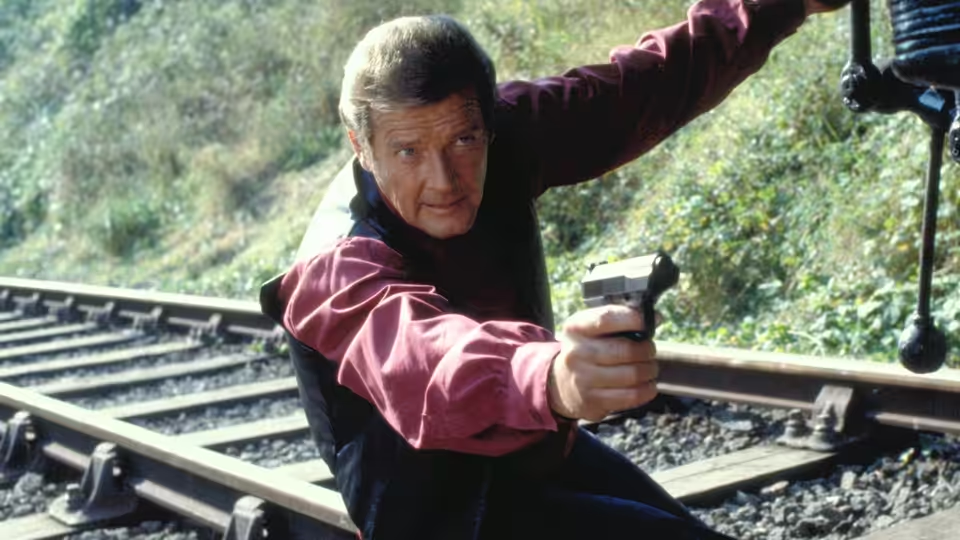
James Bond (Roger Moore) aiming a pistol while crouching beside railway tracks
Film review

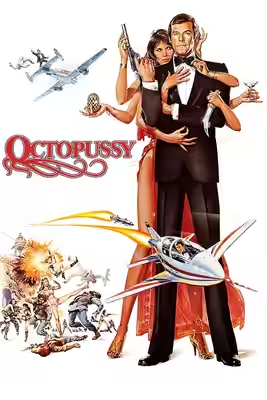
Octopussy

1983 · Directed by John Glen · 2h 11m · MPA PG

In a sentenceLouis Jourdan purrs, Steven Berkoff bellows, and Roger Moore raises an eyebrow at both of them

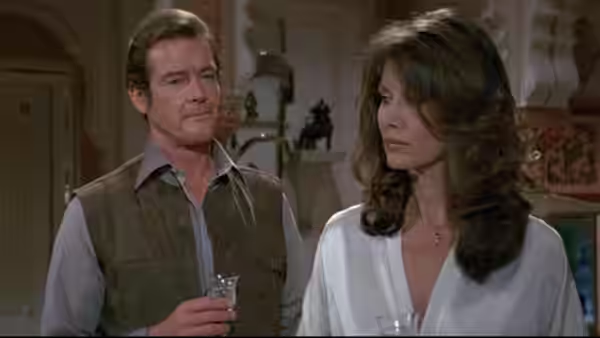
James Bond (Roger Moore) is sent on the trail of Kamal Khan (Louis Jourdan), a smooth, well-funded operator, and follows him to India, where Khan’s bodyguard Gobinda (Kabir Bedi) and the poised Magda (Kristina Wayborn) are waiting, and where a local contact, Vijay (Vijay Amritraj), lends a hand. Behind Khan stands Orlov (Steven Berkoff), a Soviet general with ambitions in Western Europe, and on a lake lives a smuggler called Octopussy (Maud Adams), whom Bond has been told to find. Q (Desmond Llewelyn) provides the gadgets, M (Robert Brown) provides the orders, and a pair of twins (David Meyer and Anthony Meyer) keep turning up wherever Bond does.

Fi1m review

John Glen’s Bond film has a proper Cold War plot at the bottom of it and keeps burying it under jokes. India looks splendid, Louis Jourdan and Steven Berkoff are good value, and Roger Moore is running out of road. One for the fond.

John Glen’s Bond film has a proper Cold War story underneath it. James Bond (Roger Moore) is sent after Kamal Khan (Louis Jourdan), a smooth, well-funded operator based in India, and behind Khan stands a Soviet general, Orlov (Steven Berkoff), who wants the Red Army in Western Europe. The screenplay, by George MacDonald Fraser, Richard Maibaum and Michael G. Wilson, knows this is a good spine for a thriller. It then keeps losing its nerve about it.

The pre-credits sequence is aerial stunt work, and it had us gripped in the old way. Alan Hume keeps the horizon in the frame so that we always know how far there is to fall, and for a few minutes nobody is joking. The film never asks us to feel anything like it again. Within the hour the gags have taken charge, and Moore is playing a man to whom danger is something that happens to other people.

India is the film’s great asset, and Hume and Peter Lamont make the most of it. The palace on the lake where Octopussy (Maud Adams) lives is shot in the gold of early evening, and Lamont fills the rooms with brass, silk and a bed the size of a small boat. Khan’s hilltop palace is white stone and empty courtyards. Emma Porteous dresses the palace in red saris and Khan in high-collared suits, and never once lets him look warm. The chase through the streets, cut fast by Henry Richardson and Peter Davies, is the film’s best sustained action, half stunt and half slapstick and honest about being both.

Jourdan is a pleasure: silk-voiced, unhurried, never raising his voice even when he is losing. Berkoff plays Orlov at full volume, pounding tables and shouting about Europe, and the two of them together are an odd, workable pair. Kabir Bedi’s Gobinda crushes dice in his fist and says almost nothing, which suits him. Moore was 55 when the film opened, and it shows in the fights, which are cut around him, and in the love scenes, which are cut around everyone. He is still good at the raised eyebrow and the dry line. He is less good at being in danger, because the film no longer believes he is.

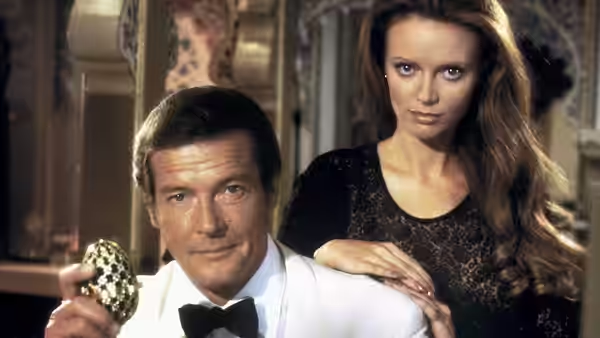
Adams plays the title character as a businesswoman who has made her peace with smuggling, and she and Moore are easy together, two adults with a history they are too polite to raise. Kristina Wayborn’s Magda gets the best exit in the film, down a balcony by way of her sari. Neither woman is given much to want beyond Bond, and the octopus cult is decoration rather than anything the film wants to think about. Vijay Amritraj is a cheerful sidekick and the target of several of the film’s weaker jokes, which tells you the level of the humour.

John Barry’s score is warm and brassy and does most of the work of persuading us the stakes are real, and the title song, All Time High, is a lovely tune. Around the middle, after Bond has been captured, the film loses its pace. We were bored for a stretch of twenty minutes, and bored by a film that has the fate of Western Europe on the table, which takes some doing. The last act gets the pace back, and we will not describe it beyond saying that it asks Moore to do things no Bond should be asked to do. It runs 131 minutes and carries a PG.

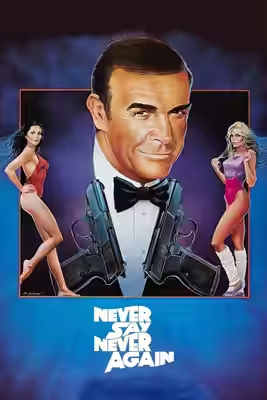
Glen moves the globe-spanning material along capably, and the gadgets are back in force. It opened in Britain on 5 June 1983, the same year as the rival Never Say Never Again, and it is the better-made of the two by some distance, which is not the same as being good.

See it for Jourdan, for India and for the opening, and bring someone who can forgive a joke at the wrong moment.
Critical consensus AI synthesised

65
Positive
6
Mixed
2
Negative
1
The AV Club
8 April 2020 · Alex McLevy
80*

The critic finds the film one of the most enjoyably over-the-top Bond outings of the Moore era, with its campy tone and absurd set pieces making it a rollicking good time. They single out the lackadaisical performance by the aging Moore and the increasingly ludicrous action sequences for their engaging, consequence-free fun.

Read the full review →
Little White Lies
26 April 2023 · Mark Allison
75*

The critic views Octopussy as a fine entry in the Bond series with striking locations, a down-to-earth Cold War plot, strong stunt work and production values. It contrasts favorably with the rival Never Say Never Again in craft, style and spectacle.

Read the full review →
The New York Times
10 June 1983 · Vincent Canby
70*

The critic finds 'Octopussy' better than most Bond films, praising its high good humor, wit, and standout action sequences like the pre-credit escape and the circus train climax despite an incomprehensible story.

Read the full review →
Time Out
10 September 2012 · JP
70*

The critic finds Bond in better form with tighter action sequences, more inventive visual gags and old panache, despite a weak plot. It highlights the shift to exotic Indian locations and Moore's performance.

Read the full review →
Variety
1 January 1983 · **
70*

The review highlights spectacular aerial stuntwork in the pre-credits teaser and climax as the film's high points, while noting the story involves a Soviet general's scheme aided by Octopussy and others, with Bond on their trail through India and Germany.

Read the full review →
Empire
1 January 2000 · Ian Nathan
60*

The oft-forgotten Bond entry suffers from an ageing Roger Moore, daft postmodern gags and unfocused villainy, but still has a good plot at its core. John Glen organises globe-spanning action effectively, with the knowing sense of humour saving it as one for the die-hards.

Read the full review →

Straight answers AI written, from our review

Is Octopussy worth watching?
Octopussy is worth watching for anyone already fond of Roger Moore's Bond, and we scored it 64. There is a proper Cold War plot underneath, India is handsomely shot, and Louis Jourdan and Steven Berkoff are good value, but the jokes keep taking charge and the film sags for a stretch after Bond is captured. Newcomers to the series will find it hard to see what the fuss was about.
How long is Octopussy, and what is it rated?
Octopussy runs 2h 11m and is rated PG by the MPA in the US. It is an adventure and action film.
Where can I watch Octopussy in the US?
Octopussy is available to rent from Amazon Prime Video and Apple TV from $2.99. Availability is checked daily; the links above go straight to each service.
How violent or frightening is Octopussy, and is it suitable for children?
Octopussy carries a PG certificate in Britain and the United States, and its violence is of the stunt-and-slapstick kind rather than anything graphic. Fights are cut around a 55-year-old Moore, the tone is jokey throughout, and the only sequence with real tension is the aerial opening. It suits older children and anyone squeamish; younger ones may simply be bored in the middle.
Is Octopussy based on a true story or a book?
Octopussy is based on a novel by Ian Fleming, not on a true story. The film's Cold War plot about a Soviet general with designs on Western Europe is a thriller invention rather than history. You do not need to have read Fleming to follow it, and knowing the book matters little to how the film plays.
Do you need to have seen the other James Bond films before Octopussy?
Octopussy stands alone and needs no knowledge of earlier James Bond films to follow. The plot is self-contained, with Bond sent after a smooth operator in India and a Soviet general behind him. It is not the best place to start, since much of its pleasure depends on fondness for Roger Moore built up over earlier entries.
What should I watch after Octopussy?
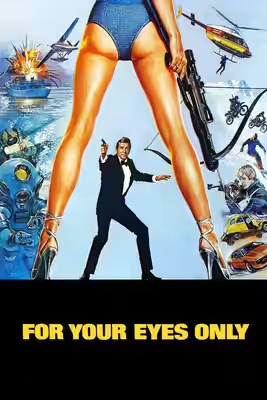
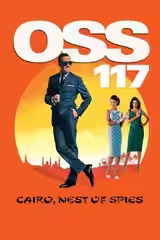
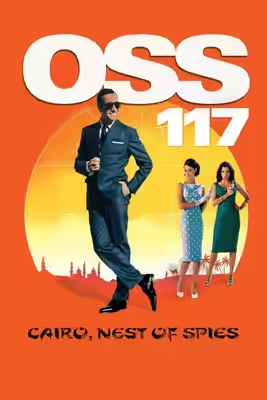
After Octopussy, try For Your Eyes Only (1981, Fi1m 68): The leaner, less silly Moore Bond, with him allowed to look his age. Then North by Northwest (1959, Fi1m 89): Hitchcock’s man-on-the-run adventure, where the jokes and the danger arrive together; and OSS 117: Cairo, Nest of Spies (2006, Fi1m 76): A French spoof that understands exactly how ridiculous this sort of thing is.
What order should I watch the James Bond films in?
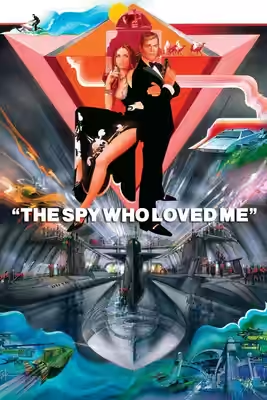
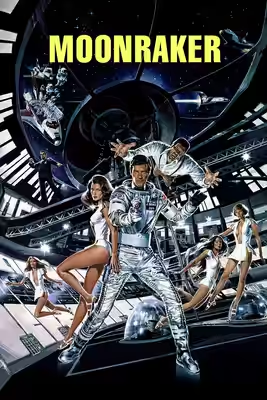
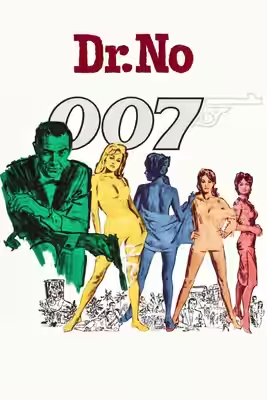
Release order is the safe choice for James Bond, and it is the order our collection page lists them in. Octopussy is number 14 of the 27 James Bond titles on Fi1m; before it comes For Your Eyes Only and after it Never Say Never Again. The full order.

Part of · 14 of 27

James Bond

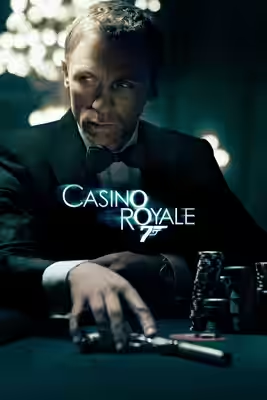
27 films on Fi1m · 1962–2021 · average 67 · best Casino Royale 86

All 27 in order

Cast

If you liked this, try…

  1. For Your Eyes Only (1981, Fi1m 68)The leaner, less silly Moore Bond, with him allowed to look his age.

  2. The Ipcress File (1965) · not reviewed yetThe Cold War spy film Bond pretends to be, with the glamour stripped out.

  3. North by Northwest (1959, Fi1m 89)Hitchcock’s man-on-the-run adventure, where the jokes and the danger arrive together.

  4. OSS 117: Cairo, Nest of Spies (2006, Fi1m 76)A French spoof that understands exactly how ridiculous this sort of thing is.

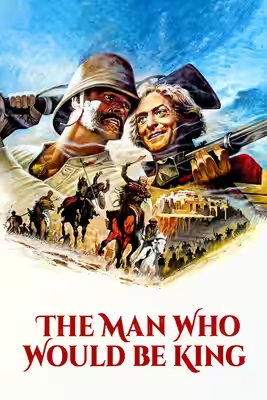
  5. The Man Who Would Be King (1975) · not reviewed yetConnery and Caine in the mountains beyond India, a proper adventure with a cost.

Free account

Know what to watch tonight

Two lists that know where things are streaming, collections you can share, your own score beside ours, and Discover that remembers what you have seen.

  • Want to see, sorted by what is streaming now
  • Seen, with your score out of ten
  • No adverts, ever